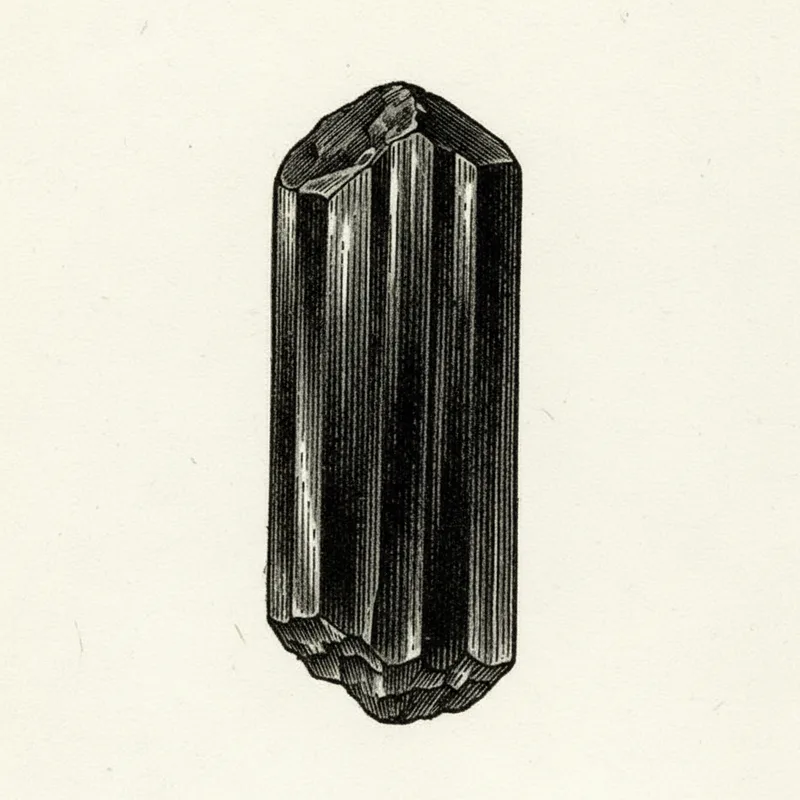
Black Tourmaline
The Shield Stone
Affiliate links. We may earn a commission, at no cost to you.
Quick Facts
Formation & Origin
Black tourmaline, properly called schorl, is the iron-rich and most common species of the tourmaline group of boron silicate (borosilicate) minerals. Black tourmaline - properly called schorl - is the most common variety of tourmaline, making up roughly 95% of all tourmaline found in nature. It forms in granitic pegmatites and metamorphic rocks where boron-rich fluids interact with iron-bearing minerals.
The deep black color comes from high iron content in the crystal structure. Schorl crystallizes as elongated, striated prisms with a distinctive rounded triangular cross-section - a shape unique to the tourmaline group. The striations (parallel grooves running lengthwise on the crystal faces) are caused by oscillating growth between different crystal faces during formation.
Black tourmaline is both pyroelectric and piezoelectric - it generates electrical charges when heated or compressed. This property was observed centuries before it was scientifically explained, contributing to its reputation as a protective stone across many cultures.
Identification Guide
Black tourmaline is identified by its characteristic striated prismatic crystals with a rounded triangular cross-section. No other common black mineral shows this combination of features. At hardness 7, it's harder than most other black minerals (obsidian is 5.5, hornblende is 5-6).
Distinguish from obsidian (glassy, no crystal faces), black hornblende (perfect cleavage in two directions), and black augite (stubby crystals, not elongated). The striations are the quickest diagnostic. If a black crystal has prominent parallel grooves running its length, it's almost certainly tourmaline.
Spotting Fakes
The diagnostic check is the surface: real black tourmaline shows lengthwise striations and a triangular cross-section, so a smooth or glassy black 'tourmaline' is something else.
- 'Black obsidian' has a completely different texture (glassy vs matte).
- Very cheap 'black tourmaline' may actually be hornblende or augite; check for the striations and triangular cross-section.
- Manufactured 'emf protection' products using 'tourmaline' are often ceramic or plastic with tourmaline powder mixed in.
Black tourmaline is abundant and inexpensive enough that outright faking is uncommon; the main issue is confusion with other black minerals.
Some links in this post go to Amazon and Etsy. Crystal Almanac earns a commission from qualifying purchases at no extra cost to you. Tools recommended here are ones we would use ourselves to run the tests described - the recommendation comes first, the link is downstream of it.
Cultural & Metaphysical Traditions
Presented as cultural traditions, not scientific evidence
Black tourmaline is the most popular protection stone in the modern crystal wellness market. Ancient magicians used it to protect against earth demons. Dutch traders in the 18th century discovered its pyroelectric property and used heated tourmaline to draw ash from pipes, calling it 'aschentrekker.' In Feng Shui, black tourmaline is placed near doorways to deflect negative energy. Modern practitioners consider it the first-line stone for energetic protection and grounding.
Metaphysical and “healing” associations are cultural traditions, not medical advice or scientific fact. Crystals are not a substitute for professional medical care.
Where It's Found
Massive deposits, large striated crystals
Well-formed prismatic crystals
Large specimens, often with quartz
Classic American pegmatite localities
Price Guide
Good to Know
Scratch test: At hardness 7, Black Tourmaline can scratch glass and steel. It's durable enough for any type of jewelry.
Global supply: Found in 4 notable locations worldwide, from Brazil to United States.
Heft test: Black Tourmaline has average mineral density (3.10). It feels about as heavy as you'd expect from a stone its size.
Common Questions
What is the chemical formula of Black Tourmaline?
The chemical formula of Black Tourmaline is NaFe₃Al₆(BO₃)₃Si₆O₁₈(OH)₄.
What is Black Tourmaline's Mohs hardness?
Black Tourmaline has a Mohs hardness of 7 on the 1 to 10 Mohs scale, hard enough to scratch glass and stand up to daily wear.
Is Black Tourmaline a mineral?
Yes. Black Tourmaline is a naturally occurring mineral (Borosilicate Group) with a definite chemical composition and an ordered crystal structure.
Care & Safety
The water, salt, and sunlight questions people actually ask before cleansing or displaying black tourmaline, answered from its hardness (Mohs 7) and chemistry (NaFe₃Al₆(BO₃)₃Si₆O₁₈(OH)₄).
Can Black Tourmaline go in water?
Yes. Black Tourmaline is hard (Mohs 7) and chemically stable, so a rinse or a quick wash with mild soap is no problem, cleanse it in water freely if that is your practice. A long soak does nothing for it either way, so skip that, and dry the stone afterward.
Can Black Tourmaline go in salt water?
Not recommended, even though black tourmaline itself is hard and not water-soluble. Salt is both corrosive and mildly abrasive: it can dull a polished surface, attack metal settings, and crystallize inside small fractures as the stone dries. Black Tourmaline's iron content also makes rust staining likely if salt residue sits on the surface. A quick dip will not destroy black tourmaline, but rinse it with fresh water afterward and dry it. For routine cleaning, plain water is the kinder choice.
Sources & References
The mineralogical and gemological data on this page is drawn from and can be cross-checked against these external references.
- WikipediaTourmaline on Wikipedia
- WebmineralSchorl mineral data (Webmineral)
- Handbook of MineralogySchorl (Handbook of Mineralogy, PDF)
- GIABlack Tourmaline in the GIA Gem Encyclopedia
Explore More
Tourmaline Group
The Protection Collection
The most popular protection stone in the modern crystal market. Pyroelectric and piezoelectric properties were observed centuries before they were scientifically explained.
The Grounding Collection
The most popular grounding crystal. Its striated crystal faces and solid black color reinforce the 'rooted' association.
The Beginner's Collection
Introduces a completely different mineral family - complex borosilicate rather than simple oxide. The striated crystal faces and triangular cross-section are distinct from any quartz variety.
The Travel Collection
The modern traveler's protection stone. Associated with energetic shielding in unfamiliar environments. Its pyroelectric properties - generating charge from temperature changes - suit a stone for changing conditions.
The Workplace Collection
The desk boundary stone. Practitioners place it at the edge of workspaces as energetic protection from workplace stress and interpersonal tension. Its pyroelectric charge is a real physical property.
The Grief Collection
The protective companion. During grief, when defenses are lowered, black tourmaline's protective association provides a sense of energetic boundary. Something to hold that keeps the world at a manageable distance.
Scorpio Season Crystals 2026: Stones for Transformation
Mercury Retrograde Crystals: July 23 and the Shadow Period
Best Crystals for Grounding and Stability
Mohs Hardness Scale
See where Black Tourmaline sits on the scale
Crystal Care Guide
Water safety, sunlight, and handling tips
Save This Stone
.%20Meaning%2C%20properties%20%26%20how%20to%20spot%20fakes%20at%20Crystal%20Almanac.)
Keep this black tourmaline reference handy. Save the card to a Pinterest board and the profile is one tap away.
Save to PinterestNewsletter
Something shiny, now and then
A stone worth knowing, or a fake worth spotting, every so often. No spam.