Cavansite
The Blue Puffball
Affiliate links. We may earn a commission, at no cost to you.
Quick Facts
Formation & Origin
Cavansite is a calcium vanadium silicate that forms in volcanic basalt cavities alongside zeolite minerals - the same environment that produces apophyllite and stilbite. The vivid blue color comes from vanadium (V⁴⁺) in the crystal structure.
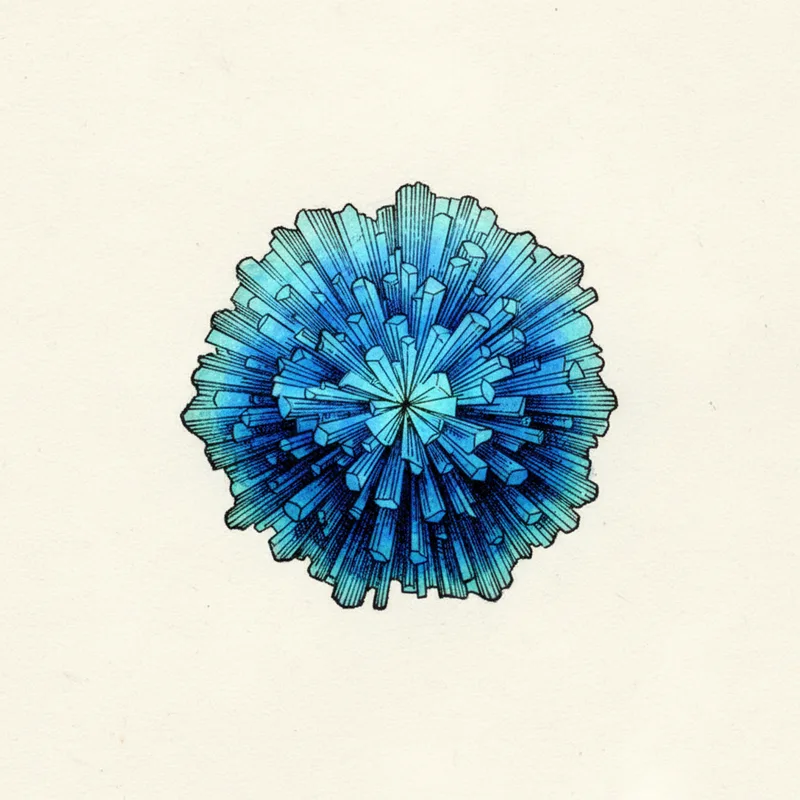
Cavansite typically grows as spherical aggregates of radiating prismatic crystals - bright blue puffball-like clusters sitting on white zeolite matrix. The visual contrast between electric blue spheres and white stilbite is one of the most striking in mineralogy. The name is an acronym: Ca-Van-Si-Te, from its chemical components (calcium, vanadium, silicon, and the ending from oxygen/ite).
First described in 1967 from Oregon, cavansite remained a rare collector curiosity until the Indian deposits near Pune began producing abundant specimens in the 1990s. The Indian material transformed cavansite from an almost unobtainable rarity to an accessible (though still uncommon) collector mineral.
Identification Guide
Cavansite is identified by its distinctive electric blue color, spherical aggregate crystal habit, and association with zeolite minerals in basalt cavities. The blue spheres on white matrix are unmistakable.
Distinguish from pentagonite (same chemistry, different crystal structure - bladed rather than spherical), azurite (copper carbonate, different blue, different associations), and blue apophyllite (different crystal form, lighter blue). Cavansite's vivid blue spherical clusters are essentially unique among common collector minerals.
Spotting Fakes
Cavansite's distinctive growth habit (spherical blue aggregates on white zeolite matrix) is very difficult to fake convincingly. The main concern is cavansite being confused with pentagonite (a polymorph with the same chemistry but different crystal form). Some low-quality specimens have cavansite spheres enhanced with dye for deeper blue. Natural cavansite varies from pale to deep blue. Artificially deepened color can sometimes be detected under magnification or with acetone testing.
Some links in this post go to Amazon and Etsy. Crystal Almanac earns a commission from qualifying purchases at no extra cost to you. Tools recommended here are ones we would use ourselves to run the tests described - the recommendation comes first, the link is downstream of it.
Cultural & Metaphysical Traditions
Presented as cultural traditions, not scientific evidence
Cavansite is too rare and recently described (1967) to have traditional associations. In modern crystal healing, its vivid blue connects it to the throat and third eye chakras. Practitioners associate it with channeling, psychic development, and clear communication of spiritual insights. Its spherical form is interpreted as representing wholeness and completion. The Indian volcanic origin connects it to transformation energy.
Metaphysical and “healing” associations are cultural traditions, not medical advice or scientific fact. Crystals are not a substitute for professional medical care.
Where It's Found
World's primary source, fine spherical aggregates
Original discovery locality (1967), rare
Minor occurrences
Price Guide
Good to Know
Scratch test: At hardness 3.5, Cavansite can be scratched with a copper coin. Handle gently and keep away from harder stones in your collection.
Global supply: Found in 3 notable locations worldwide, from India to Brazil.
Heft test: With a specific gravity of 2.33, Cavansite feels lighter than most minerals. This lightness can help identify it.
Common Questions
What is the chemical formula of Cavansite?
The chemical formula of Cavansite is Ca(VO)Si₄O₁₀·4H₂O.
What is Cavansite's Mohs hardness?
Cavansite has a Mohs hardness of 3.5 on the 1 to 10 Mohs scale, soft enough to scratch with a copper coin.
Is Cavansite a mineral?
Yes. Cavansite is a naturally occurring mineral (Phyllosilicate Group) with a definite chemical composition and an ordered crystal structure.
Care & Safety
The water, salt, and sunlight questions people actually ask before cleansing or displaying cavansite, answered from its hardness (Mohs 3.5) and chemistry (Ca(VO)Si₄O₁₀·4H₂O).
Can Cavansite go in water?
Not recommended. Cavansite can react with water, draw in moisture, or break down when it gets wet, so skip the rinse. Wipe it with a dry or barely damp cloth and dry it right away.
Can Cavansite go in salt water?
No. Cavansite is best kept away from water altogether, and salt water is the harsher version of that problem: the dissolved salt is corrosive while the stone is wet, then leaves gritty crystals behind in cracks and crevices as it dries.
Sources & References
The mineralogical and gemological data on this page is drawn from and can be cross-checked against these external references.
- WikipediaCavansite on Wikipedia
- WebmineralCavansite mineral data (Webmineral)
- Handbook of MineralogyCavansite (Handbook of Mineralogy, PDF)
Related Minerals
Same chemistry, different crystal structure
Zeolite commonly found with cavansite
Another basalt cavity mineral, often co-occurs
Different blue mineral, copper-based
Explore More
Save This Stone

Keep this cavansite reference handy. Save the card to a Pinterest board and the profile is one tap away.
Save to PinterestNewsletter
Something shiny, now and then
A stone worth knowing, or a fake worth spotting, every so often. No spam.