Boulder Opal
Australia's Ironstone Canvas
Affiliate links. We may earn a commission, at no cost to you.
Quick Facts
Formation & Origin
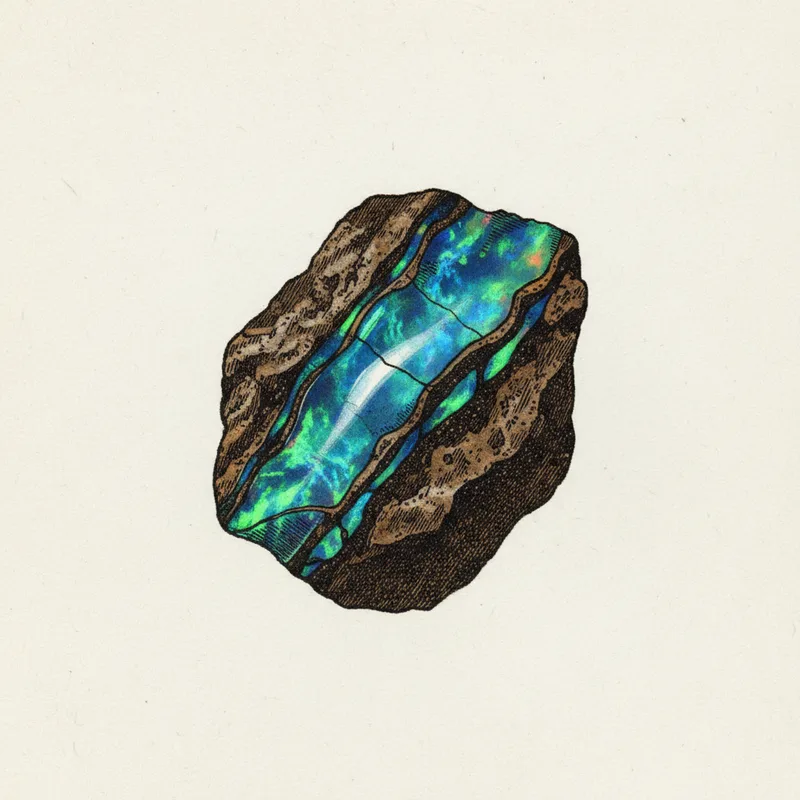
Boulder opal is precious opal, an amorphous hydrated silica mineraloid (SiO₂·nH₂O), that forms as thin seams within its natural brown ironstone host rock, which is left attached as backing. Boulder opal forms within cavities and fractures in ironstone boulders in the semi-arid regions of Queensland, Australia. Over millions of years, silica-rich groundwater percolated into cracks and voids in the Cretaceous-age sandstone and ironstone, depositing thin seams of precious opal.
Unlike solid black or white opal, boulder opal is cut with its natural ironstone backing intact. The thin opal veins follow the contours of the host rock, creating unique patterns. The dark ironstone matrix acts like a natural backing, intensifying the play-of-color. This is why boulder opal can display colors as vivid as black opal at a fraction of the price.
Yowah nuts are a distinctive variety: small, round ironstone concretions that, when split open, reveal opal lining the interior. They form when opal fills the center of naturally rounded ironstone nodules.
Identification Guide
Boulder opal is identified by its natural ironstone matrix with thin to thick veins of precious opal showing play-of-color. The stone is cut with the natural matrix backing, so the back of every boulder opal is brown ironstone. This distinguishes it from doublets and triplets (manufactured opal on a black backing).
Distinguish from opal doublets (flat, glued layers with a uniform backing), black opal (no ironstone matrix visible), and Koroit opal (a subtype with distinctive matrix patterns). Genuine boulder opal has an irregular, natural interface between opal and matrix.
Spotting Fakes
The main concern is opal doublets and triplets being sold as natural boulder opal. In a doublet, the opal/backing boundary is flat and uniform. In boulder opal, the boundary is irregular and natural. Examine the edge of the stone: boulder opal shows a gradual, uneven transition between opal and matrix. A distinct straight line suggests a manufactured doublet. Under magnification, look for small ironstone inclusions within the opal layer, which confirms natural formation.
Some links in this post go to Amazon and Etsy. Crystal Almanac earns a commission from qualifying purchases at no extra cost to you. Tools recommended here are ones we would use ourselves to run the tests described - the recommendation comes first, the link is downstream of it.
Cultural & Metaphysical Traditions
Presented as cultural traditions, not scientific evidence
Aboriginal Australians hold deep connections to opal, which features in Dreamtime stories as the footprint of the creator spirit or as solidified rainbows. Boulder opal specifically carries the energy of the Australian outback. Crystal practitioners associate it with grounding (through the ironstone) combined with inspiration and creativity (through the opal).
Metaphysical and “healing” associations are cultural traditions, not medical advice or scientific fact. Crystals are not a substitute for professional medical care.
Where It's Found
World's primary source, stunning play-of-color in ironstone
Distinctive pattern opal in dark matrix
Minor production of boulder-type opal
Price Guide
Good to Know
Scratch test: At hardness 5.5, Boulder Opal resists scratching from a knife but can be scratched by quartz. Best for pendants and earrings rather than rings.
Global supply: Found in 3 notable locations worldwide, from Australia to Brazil.
Heft test: With a specific gravity of 2.00-2.50 (varies with matrix), Boulder Opal feels lighter than most minerals. This lightness can help identify it.
Common Questions
What is the chemical formula of Boulder Opal?
The chemical formula of Boulder Opal is SiO₂·nH₂O (in ironstone matrix).
What is Boulder Opal's Mohs hardness?
Boulder Opal has a Mohs hardness of 5.5 on the 1 to 10 Mohs scale, hard enough to scratch glass but softer than quartz.
Is Boulder Opal a mineral?
Not exactly. Boulder Opal is a mineraloid: it has a mineral-like composition but lacks the ordered, repeating crystal structure required to be a true mineral.
Care & Safety
The water, salt, and sunlight questions people actually ask before cleansing or displaying boulder opal, answered from its hardness (Mohs 5.5) and chemistry (SiO₂·nH₂O (in ironstone matrix)).
Can Boulder Opal go in water?
Yes. Boulder Opal is not water-soluble and durable enough (Mohs 5.5), so a rinse or a quick wash with mild soap is no problem, cleanse it in water freely if that is your practice. A long soak does nothing for it either way, so skip that, and dry the stone afterward.
Can Boulder Opal go in salt water?
Not recommended, even though boulder opal itself is hard and not water-soluble. Salt is both corrosive and mildly abrasive: it can dull a polished surface, attack metal settings, and crystallize inside small fractures as the stone dries. A quick dip will not destroy boulder opal, but rinse it with fresh water afterward and dry it. For routine cleaning, plain water is the kinder choice.
Is sunlight safe for Boulder Opal?
The ironstone matrix is sun-proof, but the opal veins are not: heat and dehydration from prolonged direct sun can craze the precious opal layer. Boulder opal is more forgiving than solid opal, yet a shaded display spot is still the safe choice.
Sources & References
The mineralogical and gemological data on this page is drawn from and can be cross-checked against these external references.
- WikipediaOpal on Wikipedia
- WebmineralOpal mineral data (Webmineral)
- GIABoulder Opal in the GIA Gem Encyclopedia
Related Minerals
Same mineral, boulder opal is a specific formation type
Body-color variety without play-of-color
The host rock matrix
Explore More
Save This Stone

Keep this boulder opal reference handy. Save the card to a Pinterest board and the profile is one tap away.
Save to PinterestNewsletter
Something shiny, now and then
A stone worth knowing, or a fake worth spotting, every so often. No spam.