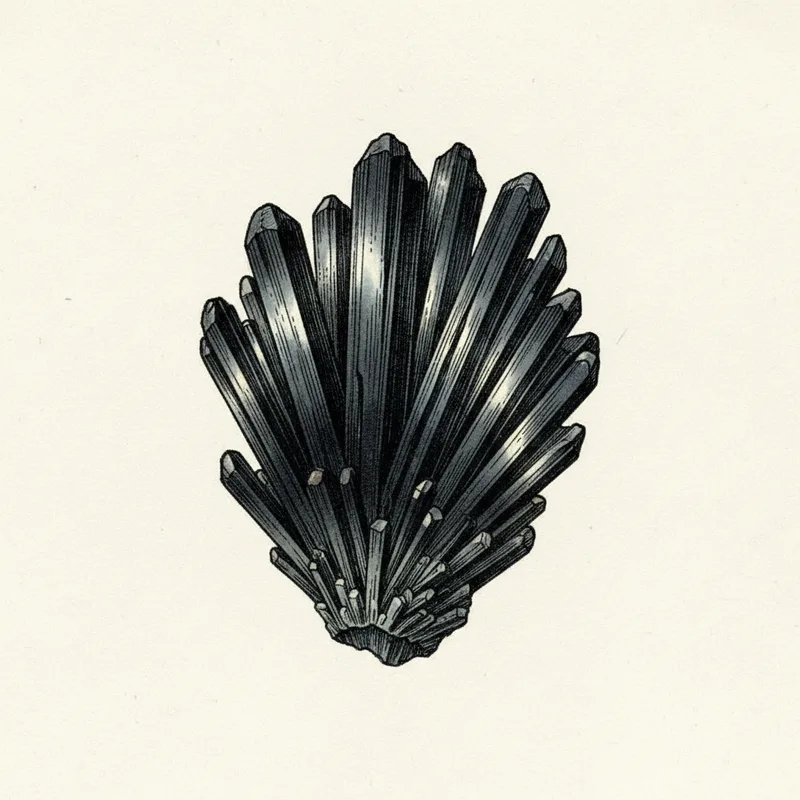
Black Kyanite
The Witch's Broom
Affiliate links. We may earn a commission, at no cost to you.
Quick Facts
Formation & Origin
Black kyanite is the same mineral as blue kyanite (Al₂SiO₅) but with higher concentrations of iron and graphite that produce the dark color. It shares blue kyanite's remarkable property of directional hardness - softer along the blade length (4.5) and harder across it (6.5-7).
What makes black kyanite visually distinctive is its habit: it frequently grows as fan-shaped or broom-like aggregates of radiating blades, sometimes called 'witch's broom' formations. These fans can spread 10-15 centimeters across, with thin black blades radiating from a central point in a dramatic spray pattern.
Black kyanite forms under the same high-pressure metamorphic conditions as blue kyanite - in aluminum-rich rocks subjected to intense tectonic pressure. The iron and graphite that produce the dark color were present in the original sedimentary rock before metamorphism.
Identification Guide
Black kyanite is identified by its dark blue-black bladed crystal habit, directional hardness (4.5 along, 6.5 across), and characteristic fan-shaped aggregates. The blade habit with variable hardness is diagnostic.
Distinguish from black tourmaline (rounded triangular cross-section, uniform hardness), hornblende (different cleavage angles), and actinolite (different crystal system). The directional hardness test is definitive: if a dark blade mineral can be scratched by a knife along its length but not across its width, it's kyanite.
Spotting Fakes
Black kyanite is affordable and distinctive enough that faking is unnecessary. The fan-shaped habit is natural and would be difficult to replicate. The directional hardness test confirms identity instantly. Some dyed or coated materials may be sold as black kyanite, but the blade habit and hardness variation are diagnostic.
Some links in this post go to Amazon and Etsy. Crystal Almanac earns a commission from qualifying purchases at no extra cost to you. Tools recommended here are ones we would use ourselves to run the tests described - the recommendation comes first, the link is downstream of it.
Cultural & Metaphysical Traditions
Presented as cultural traditions, not scientific evidence
Like blue kyanite, the black variety is said to 'never need cleansing' in crystal healing tradition. Black kyanite's fan shape is used by practitioners for energy sweeping - fanning the stone through the aura to cut negative attachments. Its blade-like form is associated with cutting through illusion and severing energetic cords. The 'witch's broom' name connects it to cleansing and sweeping away stagnant energy.
Metaphysical and “healing” associations are cultural traditions, not medical advice or scientific fact. Crystals are not a substitute for professional medical care.
Where It's Found
Primary source of fan-shaped specimens
Commercial quantities
Some material available
Price Guide
Good to Know
Scratch test: At hardness 4.5, Black Kyanite can be scratched with a copper coin. Handle gently and keep away from harder stones in your collection.
Global supply: Found in 3 notable locations worldwide, from Brazil to Kenya.
Heft test: Black Kyanite has a specific gravity of 3.67 - noticeably heavier than quartz. You'll feel the density when you pick it up.
Common Questions
What is the chemical formula of Black Kyanite?
The chemical formula of Black Kyanite is Al₂SiO₅.
What is Black Kyanite's Mohs hardness?
Black Kyanite has a Mohs hardness of 4.5 on the 1 to 10 Mohs scale, which a steel knife will scratch.
Is Black Kyanite a mineral?
Yes. Black Kyanite is a naturally occurring mineral (Nesosilicate Group) with a definite chemical composition and an ordered crystal structure.
Care & Safety
The water, salt, and sunlight questions people actually ask before cleansing or displaying black kyanite, answered from its hardness (Mohs 4.5) and chemistry (Al₂SiO₅).
Can Black Kyanite go in water?
Only briefly. A quick rinse under running water is fine for black kyanite, but do not let it soak or sit submerged. At Mohs 4.5 it is tough enough for a rinse but not for a long soak. Dry it thoroughly afterward.
Can Black Kyanite go in salt water?
No. Black Kyanite can take a brief fresh-water rinse and nothing more, and salt water is harder on it both ways: corrosive while wet, then abrasive as the salt dries into crystals. If it does meet salt water, rinse it with fresh water and dry it promptly.
Sources & References
The mineralogical and gemological data on this page is drawn from and can be cross-checked against these external references.
- WikipediaKyanite on Wikipedia
- WebmineralKyanite mineral data (Webmineral)
- Handbook of MineralogyKyanite (Handbook of Mineralogy, PDF)
Related Minerals
Same mineral, blue variety
Same Al₂SiO₅ composition, lower pressure
Same composition, high-temperature polymorph
Similar color, completely different mineral
Explore More
Save This Stone

Keep this black kyanite reference handy. Save the card to a Pinterest board and the profile is one tap away.
Save to PinterestNewsletter
Something shiny, now and then
A stone worth knowing, or a fake worth spotting, every so often. No spam.