Tiger Iron
The Banded Triad
Affiliate links. We may earn a commission, at no cost to you.
Quick Facts
Formation & Origin
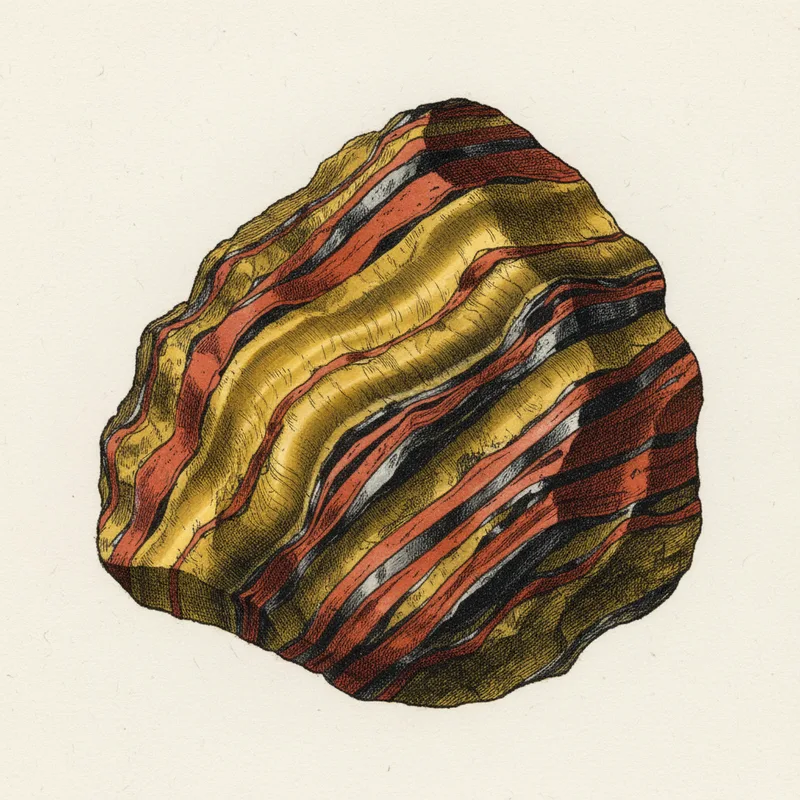
Tiger iron is a stunning combination of three minerals banded together: tiger eye (gold, silky), hematite (silver-metallic), and red jasper. It formed as part of the banded iron formations (BIFs) that were deposited on ancient ocean floors approximately 2.2-2.5 billion years ago.
During the Great Oxidation Event, photosynthetic cyanobacteria began producing oxygen, which reacted with dissolved iron in the oceans. This caused iron oxides to precipitate in alternating layers with silica-rich sediment on the seafloor. Over geological time, metamorphism transformed these layers: some iron-rich bands became hematite, some silica bands became red jasper (colored by iron), and others developed the chatoyant fibrous structure of tiger eye through the pseudomorphic replacement of crocidolite asbestos.
Every piece of tiger iron is a direct record of one of Earth's most transformative events: the moment our atmosphere gained oxygen.
Identification Guide
Tiger iron is identified by its distinct banding of three different materials: golden-brown chatoyant tiger eye, metallic-gray hematite, and deep red jasper. The banding is typically bold and clearly defined. The tiger eye bands show chatoyancy (cat's-eye shimmer) when light plays across them.
Distinguish from plain tiger eye (lacks the hematite and jasper bands), iron tiger eye (may have just two components), and banded ironstone (lacks the tiger eye chatoyancy).
Spotting Fakes
Tiger iron is not commonly faked due to its relative abundance and moderate price. The combination of chatoyant tiger eye with metallic hematite and red jasper is difficult to replicate. Be cautious of pieces where the 'hematite' bands are actually painted or where the chatoyancy is weak, indicating lower quality. The best specimens show bold, contrasting bands with strong tiger eye chatoyancy.
Some links in this post go to Amazon and Etsy. Crystal Almanac earns a commission from qualifying purchases at no extra cost to you. Tools recommended here are ones we would use ourselves to run the tests described - the recommendation comes first, the link is downstream of it.
Cultural & Metaphysical Traditions
Presented as cultural traditions, not scientific evidence
Tiger iron is considered a powerful grounding and strength stone that combines the properties of its three components. The tiger eye provides confidence and willpower, hematite offers protection and grounding, and red jasper adds vitality and endurance. Crystal practitioners often recommend it for physical stamina and emotional resilience.
Metaphysical and “healing” associations are cultural traditions, not medical advice or scientific fact. Crystals are not a substitute for professional medical care.
Where It's Found
Primary source, 2.5 billion year old banded iron formation
Classic African specimens
Some banded iron formation material
Price Guide
Good to Know
Scratch test: At hardness 7, Tiger Iron can scratch glass and steel. It's durable enough for any type of jewelry.
Global supply: Found in 3 notable locations worldwide, from Australia to Brazil.
Heft test: Tiger Iron has average mineral density (3.0-3.5). It feels about as heavy as you'd expect from a stone its size.
Common Questions
What is the chemical formula of Tiger Iron?
The chemical formula of Tiger Iron is SiO₂ + Fe₂O₃ (banded composite).
What is Tiger Iron's Mohs hardness?
Tiger Iron has a Mohs hardness of 7 on the 1 to 10 Mohs scale, hard enough to scratch glass and stand up to daily wear.
Is Tiger Iron a mineral?
Not a single mineral. Tiger Iron is a mixture of more than one mineral rather than one mineral species.
Care & Safety
The water, salt, and sunlight questions people actually ask before cleansing or displaying tiger iron, answered from its hardness (Mohs 7) and chemistry (SiO₂ + Fe₂O₃ (banded composite)).
Can Tiger Iron go in water?
Yes. Tiger Iron is hard (Mohs 7) and chemically stable, so a rinse or a quick wash with mild soap is no problem, cleanse it in water freely if that is your practice. A long soak does nothing for it either way, so skip that, and dry the stone afterward.
Can Tiger Iron go in salt water?
Not recommended, even though tiger iron itself is hard and not water-soluble. Salt is both corrosive and mildly abrasive: it can dull a polished surface, attack metal settings, and crystallize inside small fractures as the stone dries. Tiger Iron's iron content also makes rust staining likely if salt residue sits on the surface. A quick dip will not destroy tiger iron, but rinse it with fresh water afterward and dry it. For routine cleaning, plain water is the kinder choice.
Sources & References
The mineralogical and gemological data on this page is drawn from and can be cross-checked against these external references.
- WikipediaTiger's eye on Wikipedia
Explore More
Rocks & Multi-Mineral Composites
The Protection Collection
Combines three classic protection and grounding stones - tiger eye, hematite, and red jasper - in a single 2.5-billion-year-old formation. Triple the protective association in one stone.
The Grounding Collection
2.5 billion years old - formed during the Great Oxidation Event. Combines three grounding minerals (tiger eye, hematite, red jasper) into one ancient stone.
Mohs Hardness Scale
See where Tiger Iron sits on the scale
Crystal Care Guide
Water safety, sunlight, and handling tips
Save This Stone

Keep this tiger iron reference handy. Save the card to a Pinterest board and the profile is one tap away.
Save to PinterestNewsletter
Something shiny, now and then
A stone worth knowing, or a fake worth spotting, every so often. No spam.