Tibetan Quartz
The Roof of the World Crystal
Affiliate links. We may earn a commission, at no cost to you.
Quick Facts
Formation & Origin
Tibetan quartz is not a distinct mineral but a trade name for clear to smoky quartz (SiO₂), often carbon-included and double-terminated, collected from the Himalayan region. Tibetan quartz refers to quartz crystals hand-collected at extreme altitudes in the Himalayan region - typically 4,000-5,000+ meters elevation in Tibet, Nepal, and northern India. The crystals formed in alpine fissures and cavities within metamorphic and igneous rocks as part of the ongoing Himalayan mountain-building process.
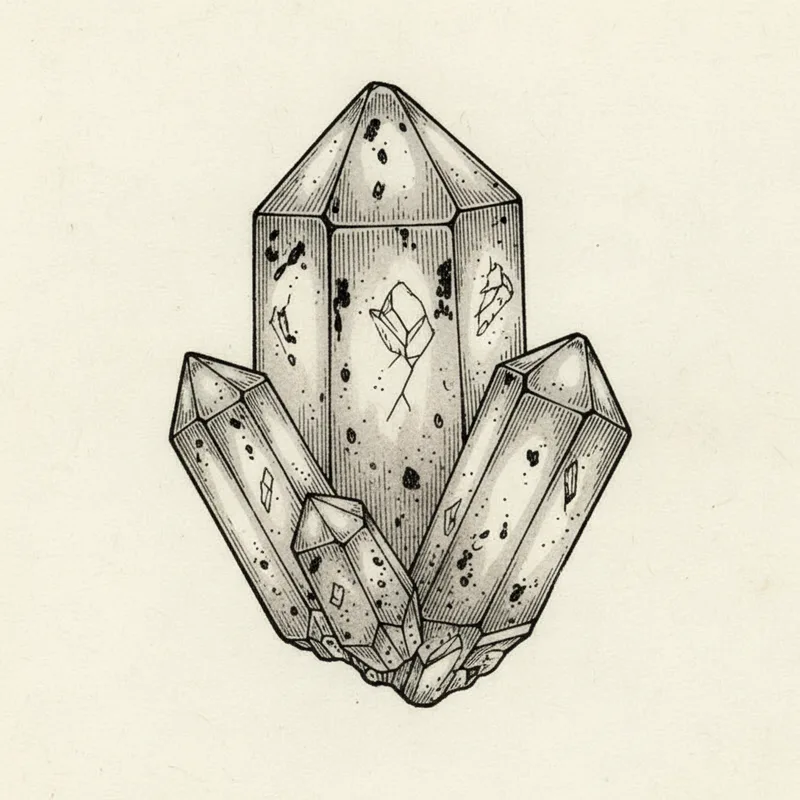
Many Tibetan quartz crystals contain distinctive black carbon or hematite inclusions that give them a unique 'dirty' or speckled appearance unlike the clean crystals from lowland Brazilian or Arkansas deposits. Some are doubly terminated (pointed at both ends), having grown freely in open fissures. The extreme altitude means collection is physically demanding - miners work at elevations that cause altitude sickness in most people, often reaching crystal pockets through hand-dug tunnels in harsh terrain.
The provenance is the primary value driver. Mineralogically, Tibetan quartz is the same SiO₂ as quartz from anywhere else. What makes it special is the collection context: crystals gathered by hand from the highest mountains on Earth, in a region deeply associated with spiritual practice.
Identification Guide
Tibetan quartz is identified as quartz with characteristic black carbon or hematite inclusions, often with a natural surface texture from high-altitude weathering. Many specimens are doubly terminated. At hardness 7, it's standard quartz.
Distinguish from regular included quartz from other localities (provenance is the distinction, not mineralogy), from Herkimer diamonds (New York origin, exceptionally clear), and from Himalayan quartz without inclusions (sold under the same name). There is no mineralogical test that confirms Tibetan origin - provenance relies on supply chain trust.
Spotting Fakes
The verification challenge with Tibetan quartz is provenance, not material identity. It's genuine quartz, but proving it's from Tibet/Nepal rather than Brazil or China is essentially impossible through testing alone. Buy from dealers who source directly from Himalayan collectors and can document the supply chain. The characteristic carbon inclusions and surface texture provide some visual consistency, but aren't definitive. The premium is for provenance and the spiritual significance of the Himalayan origin.
Some links in this post go to Amazon and Etsy. Crystal Almanac earns a commission from qualifying purchases at no extra cost to you. Tools recommended here are ones we would use ourselves to run the tests described - the recommendation comes first, the link is downstream of it.
Cultural & Metaphysical Traditions
Presented as cultural traditions, not scientific evidence
Tibetan quartz carries enormous metaphysical significance because of its origin in the world's most spiritually significant mountain range. Tibetan Buddhist monks have used crystals in meditation and ceremony for centuries. Practitioners consider crystals from this region to carry the spiritual energy of the Himalayas - the 'roof of the world' where earth meets sky. The difficulty of collection at extreme altitude adds to the perceived spiritual value. Tibetan quartz is frequently used for meditation, protection, and connecting to Buddhist and Hindu spiritual traditions.
Metaphysical and “healing” associations are cultural traditions, not medical advice or scientific fact. Crystals are not a substitute for professional medical care.
Where It's Found
High-altitude collection, 4,000-5,000m elevation
Some material from lower Himalayan elevations
Price Guide
Good to Know
Scratch test: At hardness 7, Tibetan Quartz can scratch glass and steel. It's durable enough for any type of jewelry.
Global supply: Found in 2 notable locations worldwide, from Tibet/Nepal to India.
Heft test: Tibetan Quartz has average mineral density (2.65). It feels about as heavy as you'd expect from a stone its size.
Common Questions
What is the chemical formula of Tibetan Quartz?
The chemical formula of Tibetan Quartz is SiO₂ (with carbon/hematite inclusions).
What is Tibetan Quartz's Mohs hardness?
Tibetan Quartz has a Mohs hardness of 7 on the 1 to 10 Mohs scale, hard enough to scratch glass and stand up to daily wear.
Is Tibetan Quartz a mineral?
Yes. Tibetan Quartz is a naturally occurring mineral (Quartz Family) with a definite chemical composition and an ordered crystal structure.
Care & Safety
The water, salt, and sunlight questions people actually ask before cleansing or displaying tibetan quartz, answered from its hardness (Mohs 7) and chemistry (SiO₂ (with carbon/hematite inclusions)).
Can Tibetan Quartz go in water?
Yes. Tibetan Quartz is hard (Mohs 7) and chemically stable, so a rinse or a quick wash with mild soap is no problem, cleanse it in water freely if that is your practice. A long soak does nothing for it either way, so skip that, and dry the stone afterward.
Can Tibetan Quartz go in salt water?
Not recommended, even though tibetan quartz itself is hard and not water-soluble. Salt is both corrosive and mildly abrasive: it can dull a polished surface, attack metal settings, and crystallize inside small fractures as the stone dries. A quick dip will not destroy tibetan quartz, but rinse it with fresh water afterward and dry it. For routine cleaning, plain water is the kinder choice.
Sources & References
The mineralogical and gemological data on this page is drawn from and can be cross-checked against these external references.
- WikipediaQuartz on Wikipedia
- WebmineralQuartz mineral data (Webmineral)
- Handbook of MineralogyQuartz (Handbook of Mineralogy, PDF)
Explore More
Quartz & Chalcedony
The Meditation Collection
Hand-collected at 5,000 meters in the Himalayas. Tibetan Buddhist monks have used crystals in meditation practice for centuries.
Best Crystals for Meditation: A Science-First Guide
Mohs Hardness Scale
See where Tibetan Quartz sits on the scale
Crystal Care Guide
Water safety, sunlight, and handling tips
Save This Stone

Keep this tibetan quartz reference handy. Save the card to a Pinterest board and the profile is one tap away.
Save to PinterestNewsletter
Something shiny, now and then
A stone worth knowing, or a fake worth spotting, every so often. No spam.