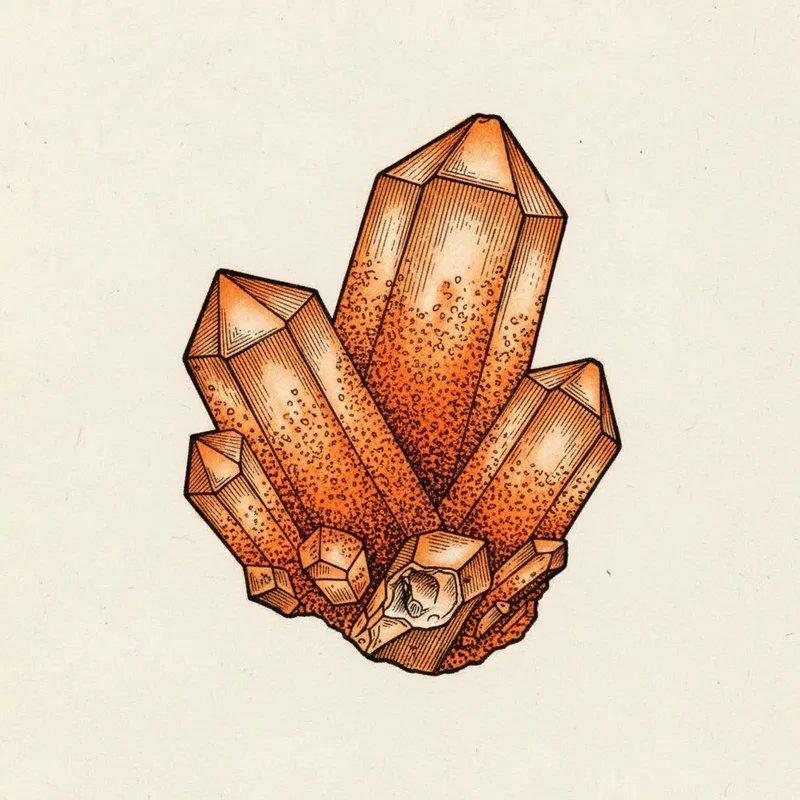
Tangerine Quartz
The Sun-Kissed Crystal
Affiliate links. We may earn a commission, at no cost to you.
Quick Facts
Formation & Origin
Tangerine quartz is clear quartz (SiO₂) whose orange color comes from a surface coating of iron oxide rather than from color centers within the lattice. Tangerine quartz gets its orange color from a thin coating of iron oxide (hematite) on the crystal surfaces. Unlike citrine, where the color comes from within the crystal lattice, tangerine quartz's color is a surface phenomenon.
The quartz crystals grew normally in hydrothermal veins. After formation, iron-rich groundwater percolated over the crystals, depositing a thin film of hematite on their surfaces. This coating is natural and permanent, though it can be scratched off with effort, revealing clear or milky quartz underneath.
The Santinho Mine in Minas Gerais, Brazil produces the most vivid specimens. The orange color ranges from pale peach to deep tangerine depending on the thickness and composition of the iron oxide coating. Some specimens show areas where the coating has naturally worn away, revealing the contrast between the orange surface and clear interior.
Identification Guide
Tangerine quartz is identified by its vivid orange surface color on otherwise normal quartz crystals. The color is a coating rather than body color: scratch a small area and clear quartz will be visible underneath. All other quartz properties are normal: hardness 7, vitreous luster, hexagonal prisms.
Distinguish from citrine (color throughout the crystal, not just surface), heat-treated amethyst/smoky quartz (internal color, often with color zoning), and carnelian (microcrystalline, waxy luster). The surface-coating origin of the color is the defining feature.
Spotting Fakes
Some sellers heat-treat amethyst or smoky quartz and sell it as tangerine quartz. True tangerine quartz has surface color from iron oxide, not internal color from lattice defects. Check by looking at crystal edges: in genuine tangerine quartz, the orange should be concentrated on the surface with clearer interior visible at edges and chip marks. Also, the coating should have a slightly matte or textured quality rather than the glassy smoothness of heat-treated quartz.
Some links in this post go to Amazon and Etsy. Crystal Almanac earns a commission from qualifying purchases at no extra cost to you. Tools recommended here are ones we would use ourselves to run the tests described - the recommendation comes first, the link is downstream of it.
Cultural & Metaphysical Traditions
Presented as cultural traditions, not scientific evidence
Tangerine quartz is associated with creativity, playfulness, and the sacral chakra in crystal healing. Practitioners connect its warm orange color to themes of joy, sensuality, and creative inspiration. It's considered a less intense alternative to carnelian for sacral chakra work. The iron coating is seen as adding grounding properties to quartz's amplification energy.
Metaphysical and “healing” associations are cultural traditions, not medical advice or scientific fact. Crystals are not a substitute for professional medical care.
Where It's Found
Primary source, vivid orange color
Some orange quartz specimens
River-tumbled orange quartz
Price Guide
Good to Know
Scratch test: At hardness 7, Tangerine Quartz can scratch glass and steel. It's durable enough for any type of jewelry.
Global supply: Found in 3 notable locations worldwide, from Brazil to South Africa.
Heft test: Tangerine Quartz has average mineral density (2.65). It feels about as heavy as you'd expect from a stone its size.
Common Questions
What is the chemical formula of Tangerine Quartz?
The chemical formula of Tangerine Quartz is SiO₂ (with iron oxide coating).
What is Tangerine Quartz's Mohs hardness?
Tangerine Quartz has a Mohs hardness of 7 on the 1 to 10 Mohs scale, hard enough to scratch glass and stand up to daily wear.
Is Tangerine Quartz a mineral?
Yes. Tangerine Quartz is a naturally occurring mineral (Quartz Family) with a definite chemical composition and an ordered crystal structure.
Care & Safety
The water, salt, and sunlight questions people actually ask before cleansing or displaying tangerine quartz, answered from its hardness (Mohs 7) and chemistry (SiO₂ (with iron oxide coating)).
Can Tangerine Quartz go in water?
Yes. Tangerine Quartz is hard (Mohs 7) and chemically stable, so a rinse or a quick wash with mild soap is no problem, cleanse it in water freely if that is your practice. A long soak does nothing for it either way, so skip that, and dry the stone afterward.
Can Tangerine Quartz go in salt water?
Not recommended, even though tangerine quartz itself is hard and not water-soluble. Salt is both corrosive and mildly abrasive: it can dull a polished surface, attack metal settings, and crystallize inside small fractures as the stone dries. A quick dip will not destroy tangerine quartz, but rinse it with fresh water afterward and dry it. For routine cleaning, plain water is the kinder choice.
Sources & References
The mineralogical and gemological data on this page is drawn from and can be cross-checked against these external references.
- WikipediaQuartz on Wikipedia
- WebmineralQuartz mineral data (Webmineral)
- Handbook of MineralogyQuartz (Handbook of Mineralogy, PDF)
Explore More
Quartz & Chalcedony
The Creative Collection
Iron-kissed quartz connected to the sacral chakra. Associated with playful creativity, sensory inspiration, and the joy of making.
Mohs Hardness Scale
See where Tangerine Quartz sits on the scale
Crystal Care Guide
Water safety, sunlight, and handling tips
Save This Stone

Keep this tangerine quartz reference handy. Save the card to a Pinterest board and the profile is one tap away.
Save to PinterestNewsletter
Something shiny, now and then
A stone worth knowing, or a fake worth spotting, every so often. No spam.