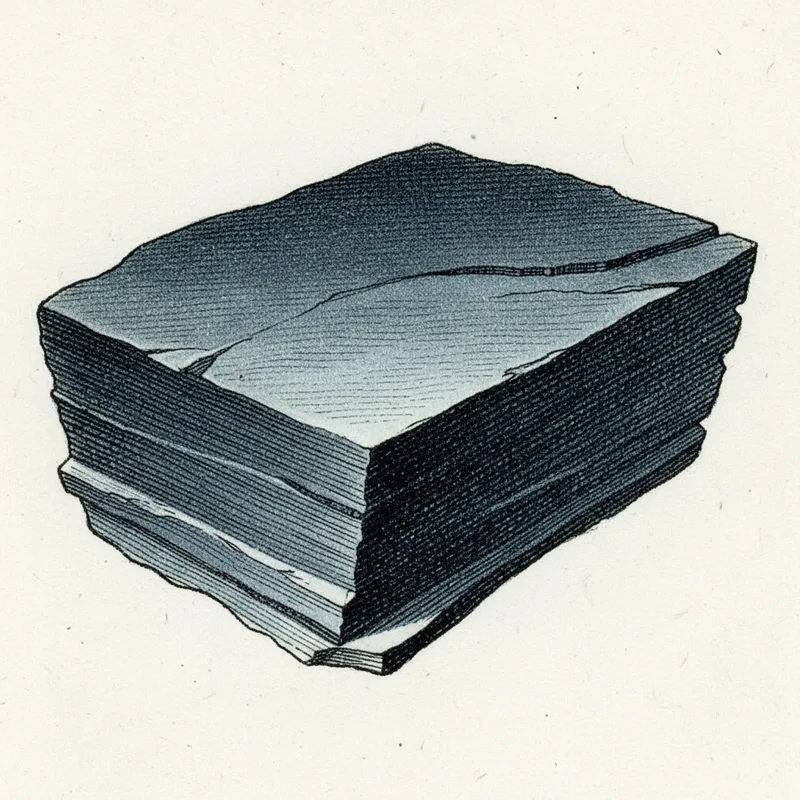
Slate
The Splitting Stone
Affiliate links. We may earn a commission, at no cost to you.
Quick Facts
Formation & Origin
Slate is a fine-grained foliated metamorphic rock, formed from clay-rich shale, that splits readily into thin, flat sheets. Slate forms when shale (a clay-rich sedimentary rock) is subjected to low-grade regional metamorphism. The pressure reorients microscopic clay and mica minerals perpendicular to the direction of compression, creating a foliation (layered structure) that allows the rock to split into thin, flat sheets.
This ability to cleave into smooth, flat sheets is called slaty cleavage, and it's what made slate one of civilization's most important building materials. Welsh slate roofs from the 1800s still protect buildings today. Before paper was cheap, students wrote on slate boards with chalk. Billiard tables use slate beds for their perfect flatness.
The dark gray color comes from organic carbon and fine-grained iron sulfide minerals. Green slate contains chlorite. Purple and red slates owe their color to iron oxides. Welsh slate is prized for its blue-gray color and ability to split into extremely thin, uniform sheets.
Identification Guide
Slate is identified by its ability to split into thin, flat sheets along cleavage planes, fine-grained texture (individual grains invisible), and characteristic gray to gray-blue color. It rings with a clear tone when tapped (used as a quality test by quarrymen).
Distinguish from shale (softer, crumbles rather than splitting cleanly), schist (coarser, visible mica flakes), and phyllite (intermediate between slate and schist, silky sheen).
Spotting Fakes
Slate is not faked, but quality varies enormously. The best roofing slate can last 200+ years. Lower-quality slate contains iron pyrite that oxidizes and causes staining and spalling. The 'ring test' (clear tone when tapped) indicates dense, high-quality slate. Dull thuds suggest internal fractures or poor quality.
Some links in this post go to Amazon and Etsy. Crystal Almanac earns a commission from qualifying purchases at no extra cost to you. Tools recommended here are ones we would use ourselves to run the tests described - the recommendation comes first, the link is downstream of it.
Cultural & Metaphysical Traditions
Presented as cultural traditions, not scientific evidence
Slate is associated with practicality, permanence, and starting fresh (the phrase 'clean slate' comes from erasing chalk from slate boards). In crystal healing, slate represents grounding, protection, and the ability to shed layers to reveal your true self.
Metaphysical and “healing” associations are cultural traditions, not medical advice or scientific fact. Crystals are not a substitute for professional medical care.
Where It's Found
Historic slate quarries, world's finest roofing slate
Major modern producer
Decorative slate production
Historic American slate belt
Price Guide
Good to Know
Scratch test: At hardness 5.5, Slate resists scratching from a knife but can be scratched by quartz. Best for pendants and earrings rather than rings.
Global supply: Found in 4 notable locations worldwide, from Wales to United States.
Heft test: Slate has average mineral density (2.7-2.8). It feels about as heavy as you'd expect from a stone its size.
Common Questions
What is the chemical formula of Slate?
The chemical formula of Slate is Quartz + Mica + Chlorite (variable).
What is Slate's Mohs hardness?
Slate has a Mohs hardness of 5.5 on the 1 to 10 Mohs scale, hard enough to scratch glass but softer than quartz.
Is Slate a mineral?
Not quite. Slate is a rock (a naturally occurring mixture of minerals), not a single mineral species.
Care & Safety
The water, salt, and sunlight questions people actually ask before cleansing or displaying slate, answered from its hardness (Mohs 5.5) and chemistry (Quartz + Mica + Chlorite (variable)).
Can Slate go in water?
Yes. Slate is not water-soluble and durable enough (Mohs 5.5), so a rinse or a quick wash with mild soap is no problem, cleanse it in water freely if that is your practice. A long soak does nothing for it either way, so skip that, and dry the stone afterward.
Can Slate go in salt water?
Not recommended, even though slate itself is hard and not water-soluble. Salt is both corrosive and mildly abrasive: it can dull a polished surface, attack metal settings, and crystallize inside small fractures as the stone dries. A quick dip will not destroy slate, but rinse it with fresh water afterward and dry it. For routine cleaning, plain water is the kinder choice.
Sources & References
The mineralogical and gemological data on this page is drawn from and can be cross-checked against these external references.
- WikipediaSlate on Wikipedia
Related Minerals
Parent rock before metamorphism
One of the mica minerals creating the foliation
Between slate and schist in metamorphic grade
Explore More
Rocks & Multi-Mineral Composites
Mercury Retrograde Crystals: July 23 and the Shadow Period
Best Crystals for Manifestation: A Practical Guide
Spring Crystal Rituals: Stones for New Beginnings
Mohs Hardness Scale
See where Slate sits on the scale
Crystal Care Guide
Water safety, sunlight, and handling tips
Save This Stone

Keep this slate reference handy. Save the card to a Pinterest board and the profile is one tap away.
Save to PinterestNewsletter
Something shiny, now and then
A stone worth knowing, or a fake worth spotting, every so often. No spam.