Quick Facts
Formation & Origin
Red beryl (also called bixbite, though this name is discouraged to avoid confusion with bixbyite) is the rarest variety of beryl, found in gem quality at only one location on Earth: the Wah Wah Mountains of southwestern Utah.
While emerald (green beryl) gets its color from chromium and aquamarine (blue beryl) from iron, red beryl's raspberry color comes from manganese (Mn³⁺). It forms in topaz-bearing rhyolite (a volcanic rock), where beryllium, manganese, aluminum, and silicon are all present in the right proportions. The geological conditions required are so specific that red beryl has never been found in gem quality anywhere else.
Red beryl crystals are tiny. Stones over 1 carat are museum pieces. A fine 2-carat red beryl is rarer and more valuable per carat than a comparable diamond. The mine produces so little material that red beryl is estimated to be 1,000 times rarer than diamond.
Identification Guide
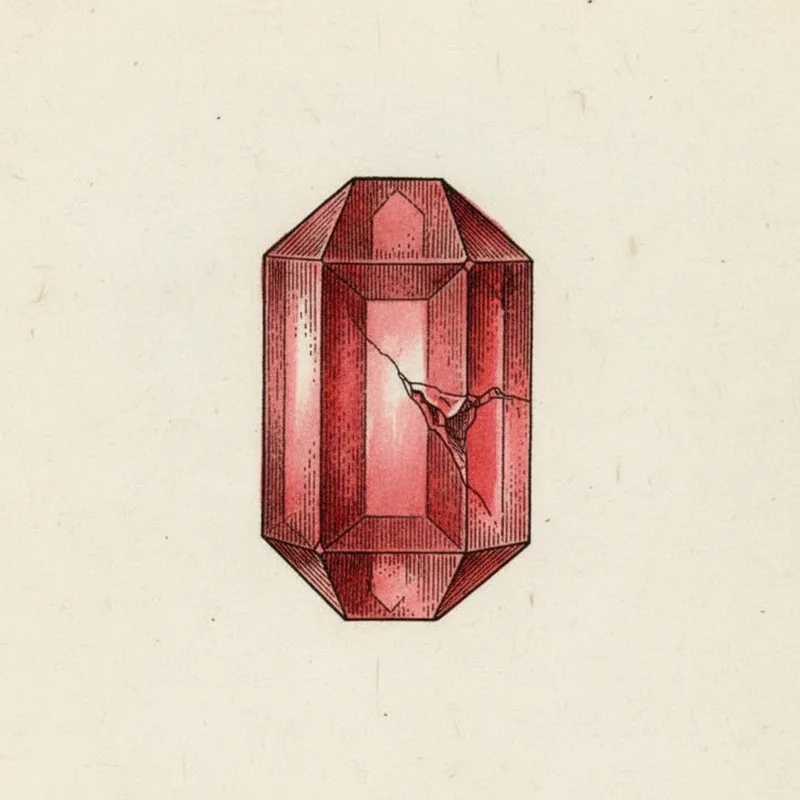
Red beryl is identified by its raspberry-red color in hexagonal prismatic crystals, beryl-family optical properties (RI 1.564-1.574), and association with topaz-bearing rhyolite. The crystals are typically small (under 2cm) and often included.
Distinguish from rubellite tourmaline (trigonal, different RI), red spinel (isometric, higher RI), and ruby (higher RI and SG). The hexagonal crystal form and beryl RI range are diagnostic.
Spotting Fakes
Lab-created red beryl exists (hydrothermal process) and is occasionally sold without disclosure. Synthetic red beryl may be too clean and vivid compared to natural stones, which are typically small and included. Any red beryl over 1 carat should be lab-certified. Provenance from the Wah Wah Mountains is essential. Red glass, red CZ, and red tourmaline are all potential substitutes at lower price points.
Some links in this post go to Amazon and Etsy. Crystal Almanac earns a commission from qualifying purchases at no extra cost to you. Tools recommended here are ones we would use ourselves to run the tests described - the recommendation comes first, the link is downstream of it.
Cultural & Metaphysical Traditions
Presented as cultural traditions, not scientific evidence
Red beryl's extreme rarity connects it to themes of finding something truly unique and irreplaceable. Crystal practitioners associate it with passionate love, personal power, and the courage to be authentic. Its beryl family membership links it to the protective and harmonizing properties attributed to emerald and aquamarine.
Metaphysical and “healing” associations are cultural traditions, not medical advice or scientific fact. Crystals are not a substitute for professional medical care.
Where It's Found
Only gem-quality source in the world
Small crystals, mostly non-gem
Very rare, mostly non-gem
Price Guide
Good to Know
Scratch test: At hardness 7.5, Red Beryl can scratch glass and steel. It's durable enough for any type of jewelry.
Global supply: Found in 3 notable locations worldwide, from United States to Mexico.
Heft test: Red Beryl has average mineral density (2.66-2.70). It feels about as heavy as you'd expect from a stone its size.
Common Questions
What is the chemical formula of Red Beryl?
The chemical formula of Red Beryl is Be₃Al₂Si₆O₁₈ (with Mn³⁺).
What is Red Beryl's Mohs hardness?
Red Beryl has a Mohs hardness of 7.5 on the 1 to 10 Mohs scale, hard enough to scratch glass and stand up to daily wear.
Is Red Beryl a mineral?
Yes. Red Beryl is a naturally occurring mineral (Beryl Family) with a definite chemical composition and an ordered crystal structure.
Care & Safety
The water, salt, and sunlight questions people actually ask before cleansing or displaying red beryl, answered from its hardness (Mohs 7.5) and chemistry (Be₃Al₂Si₆O₁₈ (with Mn³⁺)).
Can Red Beryl go in water?
Yes. Red Beryl is hard (Mohs 7.5) and chemically stable, so a rinse or a quick wash with mild soap is no problem, cleanse it in water freely if that is your practice. A long soak does nothing for it either way, so skip that, and dry the stone afterward.
Can Red Beryl go in salt water?
Not recommended, even though red beryl itself is hard and not water-soluble. Salt is both corrosive and mildly abrasive: it can dull a polished surface, attack metal settings, and crystallize inside small fractures as the stone dries. A quick dip will not destroy red beryl, but rinse it with fresh water afterward and dry it. For routine cleaning, plain water is the kinder choice.
Sources & References
The mineralogical and gemological data on this page is drawn from and can be cross-checked against these external references.
- WikipediaRed beryl on Wikipedia
- WebmineralBeryl mineral data (Webmineral)
- Handbook of MineralogyBeryl (Handbook of Mineralogy, PDF)
Explore More
Save This Stone

Keep this red beryl reference handy. Save the card to a Pinterest board and the profile is one tap away.
Save to PinterestNewsletter
Something shiny, now and then
A stone worth knowing, or a fake worth spotting, every so often. No spam.