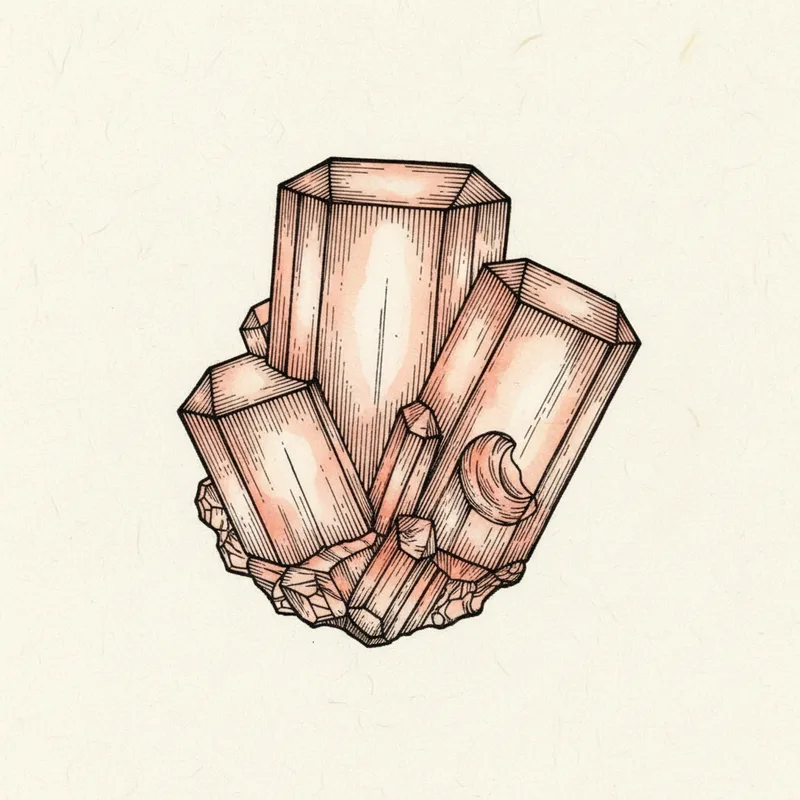
Morganite
The Divine Love Stone
Affiliate links. We may earn a commission, at no cost to you.
Quick Facts
Formation & Origin
Morganite is the pink variety of beryl - the same mineral species that includes emerald (green) and aquamarine (blue). The pink color comes from manganese (Mn²⁺) substituting into the beryl crystal structure. Like all beryl varieties, morganite forms in granitic pegmatites where beryllium-bearing fluids crystallize in the final stages of magma cooling.
Morganite was first identified in 1910 in Madagascar and named after J.P. Morgan, the American financier and gem collector, by George Frederick Kunz of Tiffany & Co. (the same Kunz who lent his name to kunzite). Morgan's gem collection, assembled by Kunz, is now housed at the American Museum of Natural History.
Morganite crystals can reach impressive sizes - specimens over 10 kg have been found in Brazil. Most gem morganite is heat-treated to improve the pink color by removing yellowish or orange overtones. This treatment is permanent, widely accepted, and transforms peach-colored material into the more desirable pure pink.
Identification Guide
Morganite is identified by its pink to peach color, hexagonal crystal habit, hardness of 7.5-8, and beryl properties (no cleavage, vitreous luster). The specific shade of pink - warm, slightly peachy - is distinctive.
Distinguish from kunzite (similar pink but different crystal system, stronger pleochroism, light-sensitive), pink tourmaline (different crystal shape, stronger color), and rose quartz (translucent massive vs transparent crystalline, much cheaper). Morganite's hexagonal crystals and beryl-family properties are diagnostic.
Spotting Fakes
Synthetic morganite doesn't exist commercially, so any genuine beryl in pink is natural. Heat treatment to improve pink color is universal and accepted. Glass and pink CZ imitations lack morganite's specific gravity and crystal properties. The main market issue is pink-coated clear beryl sold as morganite - coatings wear off over time. For engagement ring purchases (morganite's fastest-growing market), verify the stone is natural beryl with appropriate documentation.
Some links in this post go to Amazon and Etsy. Crystal Almanac earns a commission from qualifying purchases at no extra cost to you. Tools recommended here are ones we would use ourselves to run the tests described - the recommendation comes first, the link is downstream of it.
Cultural & Metaphysical Traditions
Presented as cultural traditions, not scientific evidence
Morganite is too recently named (1910) to have ancient traditions. In modern crystal practice, it's strongly associated with divine love, compassion, and emotional healing. Its popularity has surged with its adoption as an engagement ring stone - the pink color and beryl durability make it a more affordable alternative to pink sapphire or pink diamond. Practitioners associate it with attracting love, deepening relationships, and healing grief.
Metaphysical and “healing” associations are cultural traditions, not medical advice or scientific fact. Crystals are not a substitute for professional medical care.
Where It's Found
Largest crystals and major gem source
Fine pink color, significant production
Exceptional saturated pink crystals
Original discovery locality
Price Guide
Good to Know
Scratch test: At hardness 7.5, Morganite can scratch glass and steel. It's durable enough for any type of jewelry.
Global supply: Found in 4 notable locations worldwide, from Brazil to United States.
Heft test: Morganite has average mineral density (2.72). It feels about as heavy as you'd expect from a stone its size.
Common Questions
What is the chemical formula of Morganite?
The chemical formula of Morganite is Be₃Al₂Si₆O₁₈ (with Mn).
What is Morganite's Mohs hardness?
Morganite has a Mohs hardness of 7.5 on the 1 to 10 Mohs scale, hard enough to scratch glass and stand up to daily wear.
Is Morganite a mineral?
Yes. Morganite is a naturally occurring mineral (Beryl Family) with a definite chemical composition and an ordered crystal structure.
Care & Safety
The water, salt, and sunlight questions people actually ask before cleansing or displaying morganite, answered from its hardness (Mohs 7.5) and chemistry (Be₃Al₂Si₆O₁₈ (with Mn)).
Can Morganite go in water?
Yes. Morganite is hard (Mohs 7.5) and chemically stable, so a rinse or a quick wash with mild soap is no problem, cleanse it in water freely if that is your practice. A long soak does nothing for it either way, so skip that, and dry the stone afterward.
Can Morganite go in salt water?
Not recommended, even though morganite itself is hard and not water-soluble. Salt is both corrosive and mildly abrasive: it can dull a polished surface, attack metal settings, and crystallize inside small fractures as the stone dries. A quick dip will not destroy morganite, but rinse it with fresh water afterward and dry it. For routine cleaning, plain water is the kinder choice.
Is sunlight safe for Morganite?
Yes. GIA rates morganite's color as stable under light exposure, so a bright room will not cost it its pink. Heat is the caveat: GIA advises against heat exposure for morganite, so keep it away from radiators, halogen lamps, and hot car interiors rather than away from the window.
Sources & References
The mineralogical and gemological data on this page is drawn from and can be cross-checked against these external references.
- WikipediaMorganite (gem) on Wikipedia
- WebmineralBeryl mineral data (Webmineral)
- Handbook of MineralogyBeryl (Handbook of Mineralogy, PDF)
- GIAMorganite in the GIA Gem Encyclopedia
Explore More
Beryl Family
The Love Collection
Named after J.P. Morgan. Rising as an engagement ring alternative - its gentle pink and beryl durability make it practical and beautiful.
Libra Season Crystals 2026: Stones for Balance
How to Identify a Crystal by Its Mineral Group
Crystal Hardness Chart: What Mohs Means for You
Mohs Hardness Scale
See where Morganite sits on the scale
Crystal Care Guide
Water safety, sunlight, and handling tips
Save This Stone

Keep this morganite reference handy. Save the card to a Pinterest board and the profile is one tap away.
Save to PinterestNewsletter
Something shiny, now and then
A stone worth knowing, or a fake worth spotting, every so often. No spam.