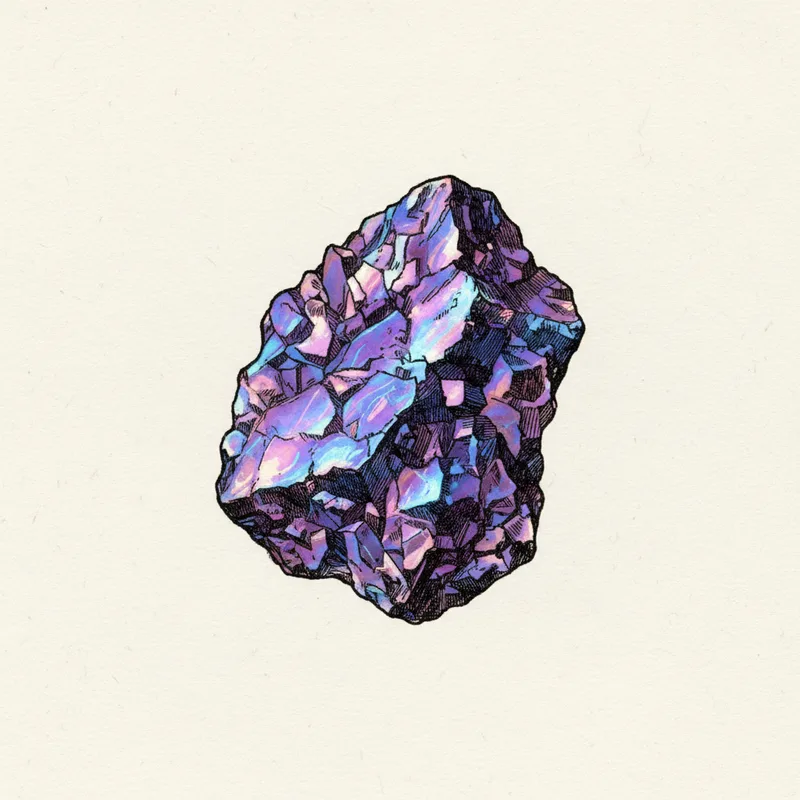
Peacock Ore
The Stone of Happiness
Affiliate links. We may earn a commission, at no cost to you.
Quick Facts
Formation & Origin
Peacock ore is the trade name for iridescent copper iron sulfides, usually bornite (Cu₅FeS₄) or acid-treated chalcopyrite (CuFeS₂), named for their colorful tarnish. Here's something most crystal sellers don't tell you: almost all 'peacock ore' in the crystal market is acid-treated chalcopyrite, not natural bornite. The two stories are different.
Genuine bornite (Cu₅FeS₄) naturally tarnishes to iridescent purple-blue when exposed to air - this is real peacock ore, and the tarnish is a thin oxide layer that creates color through thin-film interference. Natural bornite tarnish is typically dominated by purple and blue tones.
What's sold far more commonly as 'peacock ore' is chalcopyrite (CuFeS₂) that has been treated with acid to create a vivid, multicolored iridescent surface in blues, purples, golds, and greens. The acid accelerates and exaggerates the natural tarnishing process. This treated material is brighter and more colorful than natural bornite tarnish. It's not fake (both are real copper-iron sulfide minerals), but the colors are enhanced.
Identification Guide
Peacock ore is identified by its iridescent metallic surface in multiple colors and high density (feels heavy). At hardness 3 (bornite) or 3.5 (chalcopyrite), both are soft.
Distinguish from labradorite (non-metallic, silicate), bismuth (lab-grown, geometric, much heavier), and titanium-coated quartz (applied coating on quartz, different base material). The metallic base with sulfide streak and high density confirm copper-iron sulfide composition.
Spotting Fakes
The irony: most 'peacock ore' is already enhanced. Acid-treated chalcopyrite dominates the market and is sold as though the vivid iridescence is natural. Natural bornite tarnish is real but more subdued - primarily purple and blue. If the colors are extremely vivid with bright golds and greens, it's likely treated chalcopyrite. This treatment is so universal that most sellers don't even know they're selling treated material.
Some links in this post go to Amazon and Etsy. Crystal Almanac earns a commission from qualifying purchases at no extra cost to you. Tools recommended here are ones we would use ourselves to run the tests described - the recommendation comes first, the link is downstream of it.
Cultural & Metaphysical Traditions
Presented as cultural traditions, not scientific evidence
Peacock ore's full-spectrum iridescence has made it popular as a 'happiness stone' in the crystal market. The multiple colors are associated with activating all chakras simultaneously and shifting perception from negative to positive. In geological traditions, bornite is an important copper ore mineral. The disconnect between its industrial importance and its crystal market role as a 'joy stone' is one of the more interesting cultural contrasts in the mineral world.
Metaphysical and “healing” associations are cultural traditions, not medical advice or scientific fact. Crystals are not a substitute for professional medical care.
Where It's Found
Major source of treated chalcopyrite 'peacock ore'
Natural bornite specimens
Good natural bornite specimens
Price Guide
Good to Know
Scratch test: At hardness 3, Peacock Ore can be scratched with a copper coin. Handle gently and keep away from harder stones in your collection.
Global supply: Found in 3 notable locations worldwide, from Mexico to Peru.
Heft test: With a specific gravity of 5.07, Peacock Ore feels surprisingly heavy for its size. This weight is actually a useful identification tool.
Common Questions
What is the chemical formula of Peacock Ore?
The chemical formula of Peacock Ore is Cu₅FeS₄ (bornite) or CuFeS₂ (chalcopyrite, treated).
What is Peacock Ore's Mohs hardness?
Peacock Ore has a Mohs hardness of 3 on the 1 to 10 Mohs scale, soft enough to scratch with a copper coin.
Is Peacock Ore a mineral?
Yes. Peacock Ore is a naturally occurring mineral (Sulfide Group) with a definite chemical composition and an ordered crystal structure.
Care & Safety
The water, salt, and sunlight questions people actually ask before cleansing or displaying peacock ore, answered from its hardness (Mohs 3) and chemistry (Cu₅FeS₄ (bornite) or CuFeS₂ (chalcopyrite, treated)).
Can Peacock Ore go in water?
Not recommended. At Mohs 3, peacock ore is soft enough that water can slowly dull, etch, or wear down the surface, so a water cleanse does more harm than good here. Reach for a dry cloth instead.
Can Peacock Ore go in salt water?
No. Peacock Ore is best kept away from water altogether, and salt water is the harsher version of that problem: the dissolved salt is corrosive while the stone is wet, then leaves gritty crystals behind in cracks and crevices as it dries. Peacock Ore's iron content also makes rust staining likely if salt residue sits on the surface.
Sources & References
The mineralogical and gemological data on this page is drawn from and can be cross-checked against these external references.
- WikipediaBornite on Wikipedia
Related Minerals
The mineral most 'peacock ore' actually IS
The mineral that naturally tarnishes iridescent (true peacock ore)
Another metallic sulfide, golden
The element both minerals contain
Explore More
Save This Stone

Keep this peacock ore reference handy. Save the card to a Pinterest board and the profile is one tap away.
Save to PinterestNewsletter
Something shiny, now and then
A stone worth knowing, or a fake worth spotting, every so often. No spam.