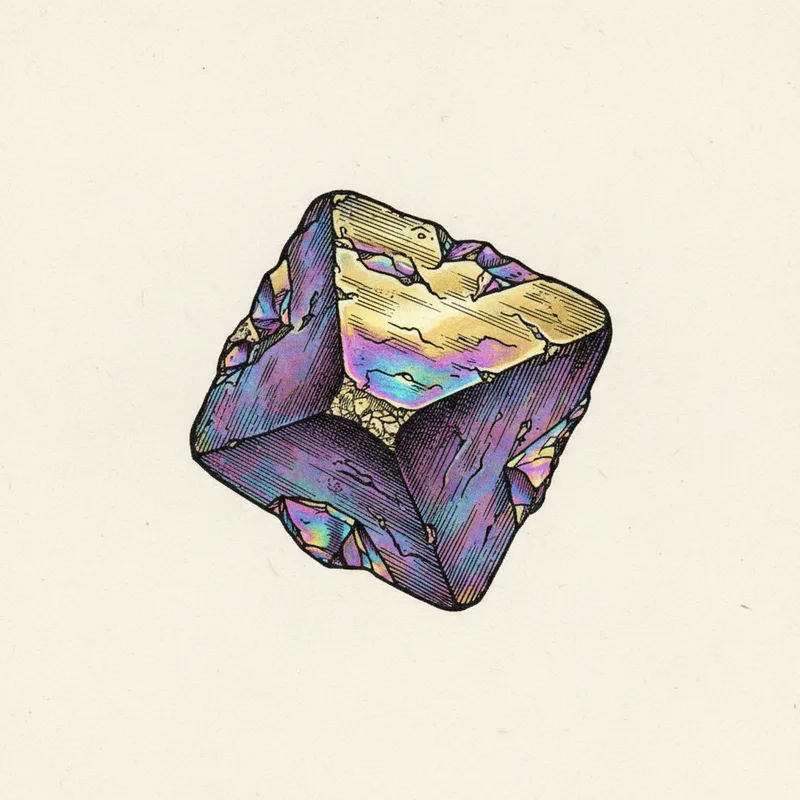
Chalcopyrite
The Peacock Mineral
Affiliate links. We may earn a commission, at no cost to you.
Quick Facts
Formation & Origin
Chalcopyrite is the most important copper ore mineral on Earth, responsible for approximately 70% of the world's copper production. It forms in a wide range of geological environments: hydrothermal veins, porphyry copper deposits, massive sulfide deposits, and contact metamorphic zones.
Fresh chalcopyrite has a brass-yellow metallic color that can be confused with gold (hence the old name 'copper pyrite'). However, when exposed to air and moisture, the surface develops a stunning iridescent tarnish in electric blues, purples, and magentas. This is the 'peacock ore' effect. Note: most 'peacock ore' sold in the crystal market is actually bornite or chalcopyrite that has been acid-treated to accelerate the tarnishing process.
Chalcopyrite's tetragonal crystal system produces distinctive tetrahedral crystals that look like four-sided pyramids. Twinned crystals, where two individuals interpenetrate, create complex, visually striking specimens.
Identification Guide
Chalcopyrite is identified by its brass-yellow color on fresh surfaces, greenish-black streak (distinguishing it from pyrite's black streak and gold's yellow streak), and relatively low hardness (3.5, softer than pyrite's 6).
Distinguish from pyrite (harder, cubic crystals, black streak), gold (much heavier, malleable, yellow streak), and bornite (darker bronze, different tarnish pattern). Chalcopyrite is softer than a steel knife and produces a green-black streak on unglazed porcelain.
Spotting Fakes
Most 'peacock ore' on the market has been acid-treated to create or enhance the iridescent tarnish. Natural tarnish develops slowly and is typically less vivid than the electric blues and purples of treated material. This doesn't make the mineral fake (it's still genuine chalcopyrite or bornite), but the tarnish is artificially enhanced. For untarnished specimen crystals, the main confusion is with pyrite. Check hardness (chalcopyrite 3.5 vs pyrite 6) and streak color.
Some links in this post go to Amazon and Etsy. Crystal Almanac earns a commission from qualifying purchases at no extra cost to you. Tools recommended here are ones we would use ourselves to run the tests described - the recommendation comes first, the link is downstream of it.
Cultural & Metaphysical Traditions
Presented as cultural traditions, not scientific evidence
Chalcopyrite is associated with meditation, bridging spiritual and physical worlds, and finding hidden truths. The iridescent tarnish is interpreted as revealing hidden beauty through transformation. Practitioners use it for removing energetic blockages and aligning the chakras. Some traditions associate it with prosperity due to its gold-like appearance and role as a source of copper.
Metaphysical and “healing” associations are cultural traditions, not medical advice or scientific fact. Crystals are not a substitute for professional medical care.
Where It's Found
Fine crystal specimens
Excellent crystal groups
Classic twinned crystal specimens
The world's most important copper ore mineral
Price Guide
Good to Know
Scratch test: At hardness 3.5, Chalcopyrite can be scratched with a copper coin. Handle gently and keep away from harder stones in your collection.
Global supply: Found in 4 notable locations worldwide, from Mexico to Worldwide.
Heft test: Chalcopyrite has a specific gravity of 4.1-4.3 - noticeably heavier than quartz. You'll feel the density when you pick it up.
Common Questions
What is the chemical formula of Chalcopyrite?
The chemical formula of Chalcopyrite is CuFeS₂.
What is Chalcopyrite's Mohs hardness?
Chalcopyrite has a Mohs hardness of 3.5 on the 1 to 10 Mohs scale, soft enough to scratch with a copper coin.
Is Chalcopyrite a mineral?
Yes. Chalcopyrite is a naturally occurring mineral (Sulfide Mineral) with a definite chemical composition and an ordered crystal structure.
Care & Safety
The water, salt, and sunlight questions people actually ask before cleansing or displaying chalcopyrite, answered from its hardness (Mohs 3.5) and chemistry (CuFeS₂).
Can Chalcopyrite go in water?
Not recommended. Chalcopyrite can react with water, draw in moisture, or break down when it gets wet, so skip the rinse. Wipe it with a dry or barely damp cloth and dry it right away.
Can Chalcopyrite go in salt water?
No. Chalcopyrite is best kept away from water altogether, and salt water is the harsher version of that problem: the dissolved salt is corrosive while the stone is wet, then leaves gritty crystals behind in cracks and crevices as it dries. Chalcopyrite's iron content also makes rust staining likely if salt residue sits on the surface.
Sources & References
The mineralogical and gemological data on this page is drawn from and can be cross-checked against these external references.
- WikipediaChalcopyrite on Wikipedia
- WebmineralChalcopyrite mineral data (Webmineral)
- Handbook of MineralogyChalcopyrite (Handbook of Mineralogy, PDF)
Related Minerals
Similar color but harder, different streak
Copper iron sulfide, similar tarnish behavior
Fellow copper sulfide with iridescence
Explore More
Save This Stone
%20and%20streak%20color.%20Meaning%2C%20properties%20%26%20how%20to%20spot%20fakes%20at%20Crystal%20Almanac.)
Keep this chalcopyrite reference handy. Save the card to a Pinterest board and the profile is one tap away.
Save to PinterestNewsletter
Something shiny, now and then
A stone worth knowing, or a fake worth spotting, every so often. No spam.