Quick Facts
Formation & Origin
Painite is a rare borate mineral (CaZrBAl₉O₁₈), a calcium zirconium aluminum borate that crystallizes in the hexagonal system. Painite held the Guinness World Record as the world's rarest mineral for decades. From its discovery in 1951 until 2005, fewer than 25 crystals were known to exist in the entire world. Recent finds in Myanmar have increased the count to over 1,000 known specimens, but gem-quality material remains extraordinarily rare.
Painite was discovered by British gemologist Arthur C.D. Pain in Mogok, Myanmar. For over 50 years it was known from only three crystals and remained a near-mythical collector item. The extreme rarity results from its unusual chemistry: it requires calcium, zirconium, boron, and aluminum all present in precise proportions in the same geological environment.
It forms in metamorphosed limestone (marble) alongside ruby, sapphire, and spinel in Myanmar's legendary Mogok Stone Tract. The same geological kitchen that produces some of the world's finest gemstones also created one of its rarest minerals.
Identification Guide
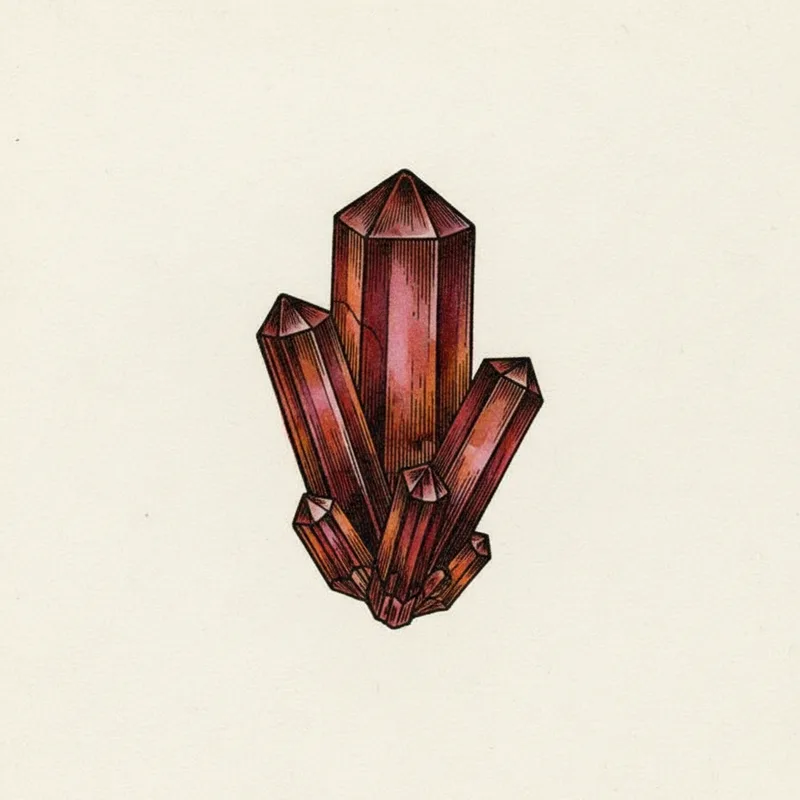
Painite is identified by its dark brownish-red color (similar to dark garnet), hexagonal crystal system, hardness of 8, and very high specific gravity (4.01). Strong pleochroism shows different colors from different angles: red, brown, and pale yellow.
Distinguish from garnet (isometric, singly refractive), ruby (trigonal, different SG), and dark tourmaline (trigonal, lower SG). Lab verification is essential for any claimed painite.
Spotting Fakes
Any stone claimed to be painite absolutely requires lab certification from GIA, Gübelin, SSEF, or another reputable gemological laboratory. Dark garnet, dark tourmaline, and other brown-red gems could be mistaken for or deliberately substituted. The combination of hexagonal crystal system, hardness 8, SG 4.01, and strong pleochroism narrows identification considerably, but the stakes warrant professional testing.
Some links in this post go to Amazon and Etsy. Crystal Almanac earns a commission from qualifying purchases at no extra cost to you. Tools recommended here are ones we would use ourselves to run the tests described - the recommendation comes first, the link is downstream of it.
Cultural & Metaphysical Traditions
Presented as cultural traditions, not scientific evidence
Painite's extreme rarity gives it a near-mythical status. Crystal practitioners associate it with recognizing your own unique value and the power of patience. The 50 years between discovery and broader availability connects it to themes of delayed gratification and hidden treasure. Its rarity means few practitioners have actually worked with it.
Metaphysical and “healing” associations are cultural traditions, not medical advice or scientific fact. Crystals are not a substitute for professional medical care.
Where It's Found
Only significant source, all known specimens from here
Secondary locality, lower-quality material
Price Guide
Good to Know
Scratch test: At hardness 8, Painite can scratch glass and steel. It's durable enough for any type of jewelry.
Global supply: Found in 2 notable locations worldwide, from Myanmar to Myanmar.
Heft test: Painite has a specific gravity of 4.01 - noticeably heavier than quartz. You'll feel the density when you pick it up.
Common Questions
What is the chemical formula of Painite?
The chemical formula of Painite is CaZrBAl₉O₁₈.
What is Painite's Mohs hardness?
Painite has a Mohs hardness of 8 on the 1 to 10 Mohs scale, hard enough to scratch glass and stand up to daily wear.
Is Painite a mineral?
Yes. Painite is a naturally occurring mineral (Borate Mineral) with a definite chemical composition and an ordered crystal structure.
Care & Safety
The water, salt, and sunlight questions people actually ask before cleansing or displaying painite, answered from its hardness (Mohs 8) and chemistry (CaZrBAl₉O₁₈).
Can Painite go in water?
Yes. Painite is hard (Mohs 8) and chemically stable, so a rinse or a quick wash with mild soap is no problem, cleanse it in water freely if that is your practice. A long soak does nothing for it either way, so skip that, and dry the stone afterward.
Can Painite go in salt water?
Not recommended, even though painite itself is hard and not water-soluble. Salt is both corrosive and mildly abrasive: it can dull a polished surface, attack metal settings, and crystallize inside small fractures as the stone dries. A quick dip will not destroy painite, but rinse it with fresh water afterward and dry it. For routine cleaning, plain water is the kinder choice.
Sources & References
The mineralogical and gemological data on this page is drawn from and can be cross-checked against these external references.
- WikipediaPainite on Wikipedia
- WebmineralPainite mineral data (Webmineral)
- Handbook of MineralogyPainite (Handbook of Mineralogy, PDF)
Explore More
Save This Stone

Keep this painite reference handy. Save the card to a Pinterest board and the profile is one tap away.
Save to PinterestNewsletter
Something shiny, now and then
A stone worth knowing, or a fake worth spotting, every so often. No spam.