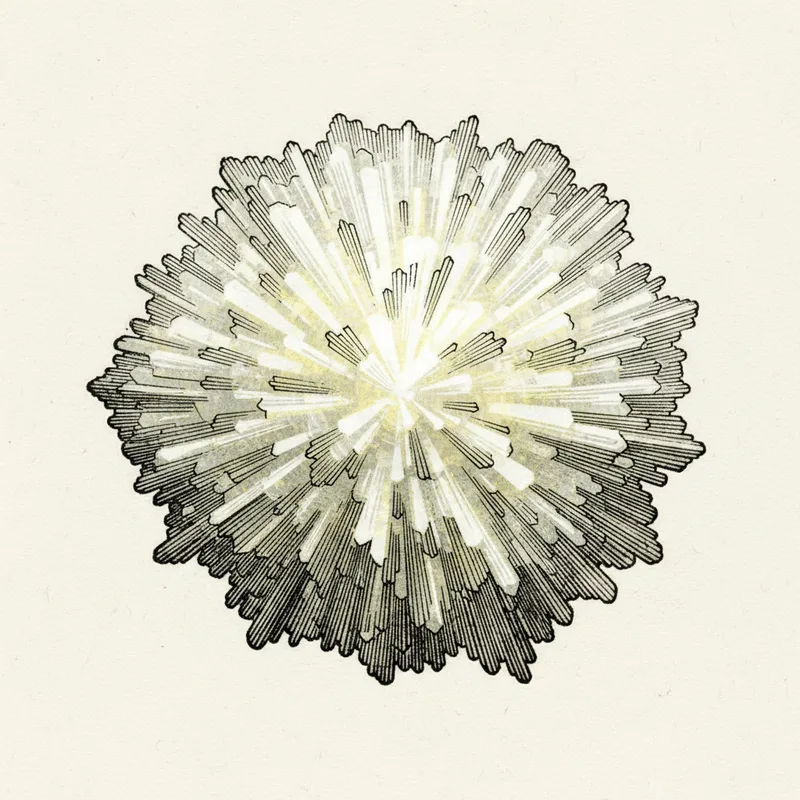
Okenite
The Cotton Ball Crystal
Affiliate links. We may earn a commission, at no cost to you.
Quick Facts
Formation & Origin
Okenite is a hydrated calcium silicate mineral (CaSi₂O₅·2H₂O) that grows as fine, hair-like fibers bundled into soft white spheres resembling cotton balls. Okenite forms as a secondary mineral in basalt cavities (vesicles), deposited by hydrothermal fluids at relatively low temperatures (below 200°C). It grows as extremely fine, hair-like crystal fibers that bundle together into soft, fuzzy spherical aggregates resembling cotton balls or snowballs.
The most spectacular specimens come from India's Deccan Traps, a massive basaltic lava province covering much of western India. As these ancient lavas cooled, gas bubbles were trapped, creating cavities. Over millions of years, hot groundwater circulated through these cavities, depositing zeolite minerals and okenite.
Okenite often grows alongside gyrolite, apophyllite, and various zeolites, creating stunning miniature crystal gardens within basalt geodes. The delicate fiber aggregates form last in the mineral sequence, sitting on top of earlier-formed minerals.
Identification Guide
Okenite's distinctive cotton-ball appearance is unmistakable. The white, fuzzy spherical aggregates of extremely fine crystal fibers look exactly like small snowballs or cotton balls sitting in basalt cavities. No other mineral forms quite like this.
Distinguish from mesolite (straight needle-like crystals rather than fuzzy balls), thomsonite (more compact, radiating crystals), and actual cotton or synthetic fibers (okenite is a mineral and won't burn like organic fibers). Handle with extreme care: the delicate fibers are easily damaged.
Spotting Fakes
Okenite is not commonly faked. The main concern is damage. Because the crystal fibers are so delicate, handling damages specimens quickly. Collectors prize pieces with intact, fluffy, undamaged cotton-ball formations. Compressed, matted, or yellowish specimens have been damaged or improperly stored. Never touch okenite with bare hands, as oils from skin will mat the fibers permanently.
Some links in this post go to Amazon and Etsy. Crystal Almanac earns a commission from qualifying purchases at no extra cost to you. Tools recommended here are ones we would use ourselves to run the tests described - the recommendation comes first, the link is downstream of it.
Cultural & Metaphysical Traditions
Presented as cultural traditions, not scientific evidence
Okenite is associated with purity, truth, and self-forgiveness in crystal healing. Its soft, gentle appearance connects it to themes of tenderness and compassion. Practitioners sometimes call it a 'truth stone' believed to help release denial and accept difficult truths with grace. The delicate nature of the mineral reinforces lessons about treating precious things (and people) with care.
Metaphysical and “healing” associations are cultural traditions, not medical advice or scientific fact. Crystals are not a substitute for professional medical care.
Where It's Found
World's premier source for cotton-ball formations
Basaltic cavity specimens
Specimens from copper mining areas
Original discovery locality
Price Guide
Good to Know
Scratch test: At hardness 4.5, Okenite can be scratched with a copper coin. Handle gently and keep away from harder stones in your collection.
Global supply: Found in 4 notable locations worldwide, from India to Greenland.
Heft test: With a specific gravity of 2.28-2.33, Okenite feels lighter than most minerals. This lightness can help identify it.
Common Questions
What is the chemical formula of Okenite?
The chemical formula of Okenite is CaSi₂O₅·2H₂O.
What is Okenite's Mohs hardness?
Okenite has a Mohs hardness of 4.5 on the 1 to 10 Mohs scale, which a steel knife will scratch.
Is Okenite a mineral?
Yes. Okenite is a naturally occurring mineral (Silicate Mineral (Phyllosilicate)) with a definite chemical composition and an ordered crystal structure.
Care & Safety
The water, salt, and sunlight questions people actually ask before cleansing or displaying okenite, answered from its hardness (Mohs 4.5) and chemistry (CaSi₂O₅·2H₂O).
Can Okenite go in water?
Only briefly. A quick rinse under running water is fine for okenite, but do not let it soak or sit submerged. At Mohs 4.5 it is tough enough for a rinse but not for a long soak. Dry it thoroughly afterward.
Can Okenite go in salt water?
No. Okenite can take a brief fresh-water rinse and nothing more, and salt water is harder on it both ways: corrosive while wet, then abrasive as the salt dries into crystals. If it does meet salt water, rinse it with fresh water and dry it promptly.
Sources & References
The mineralogical and gemological data on this page is drawn from and can be cross-checked against these external references.
- WikipediaOkenite on Wikipedia
- WebmineralOkenite mineral data (Webmineral)
- Handbook of MineralogyOkenite (Handbook of Mineralogy, PDF)
Related Minerals
Often found together in basalt cavities
Common companion mineral in Indian basalts
Zeolite frequently found in same cavities
Explore More
Save This Stone

Keep this okenite reference handy. Save the card to a Pinterest board and the profile is one tap away.
Save to PinterestNewsletter
Something shiny, now and then
A stone worth knowing, or a fake worth spotting, every so often. No spam.