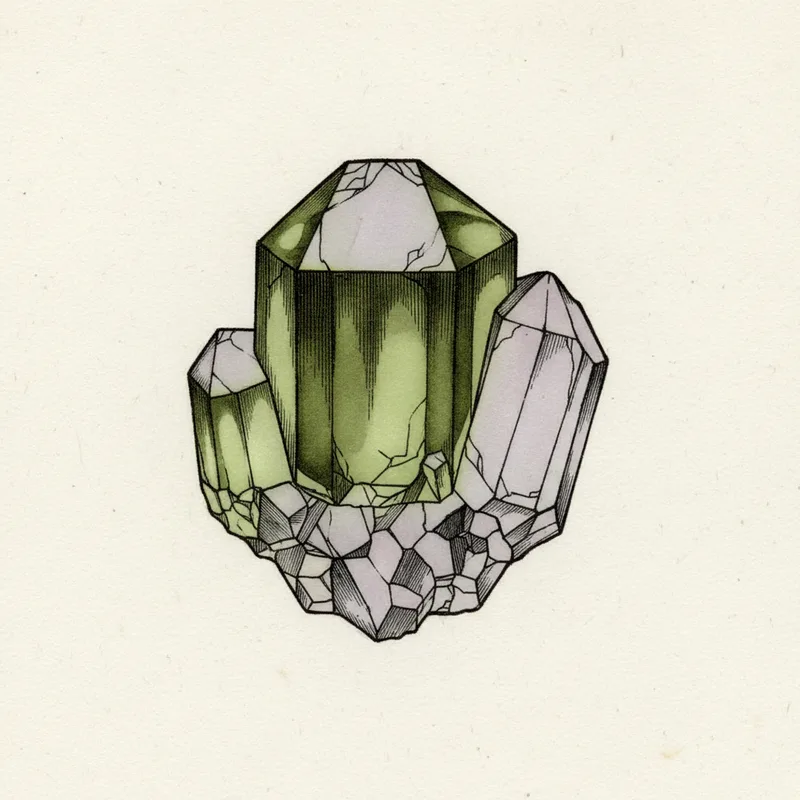
Quick Facts
Formation & Origin
Musgravite is closely related to taaffeite and is possibly even rarer. It was discovered in 1967 in the Musgrave Ranges of central Australia and for decades was known from only a handful of tiny specimens.
The mineral forms in high-grade metamorphic rocks, specifically in granulite-facies rocks where extreme temperatures and pressures produce unusual mineral assemblages. The beryllium-magnesium-aluminum chemistry requires conditions found in only a few geological settings on Earth.
Gem-quality musgravite was essentially unknown until 2005, when a few transparent stones were identified and faceted. These are among the rarest faceted gemstones in existence. The total number of gem-quality musgravite stones known is estimated at fewer than 20, making it a contender for the title of rarest gem in the world.
Identification Guide
Musgravite is identified by its grayish-green to violet-gray color, hardness of 8, trigonal crystal system, and SG of 3.68. It's closely related to taaffeite but has a different crystal structure (trigonal vs. hexagonal) and slightly higher SG.
Distinguish from taaffeite (hexagonal, slightly lower SG), spinel (isometric, singly refractive), and sapphire (different RI range). Professional laboratory analysis is the only reliable method for distinguishing musgravite from taaffeite.
Spotting Fakes
Musgravite is so rare that most gemologists have never seen one. Any claimed musgravite absolutely requires certification from a major gemological laboratory with experience in rare gems (GIA, Gübelin, SSEF). The distinction from taaffeite requires advanced crystallographic analysis. Given that fewer than 20 gem-quality specimens are believed to exist, extraordinary claims require extraordinary proof.
Some links in this post go to Amazon and Etsy. Crystal Almanac earns a commission from qualifying purchases at no extra cost to you. Tools recommended here are ones we would use ourselves to run the tests described - the recommendation comes first, the link is downstream of it.
Cultural & Metaphysical Traditions
Presented as cultural traditions, not scientific evidence
Musgravite is essentially unknown in the crystal healing world due to its extreme rarity. The few practitioners who have encountered it describe it as carrying an ancient, profound energy connected to Earth's deepest geological processes. Its Australian outback origins connect it to Aboriginal Dreamtime concepts of deep time and creation.
Metaphysical and “healing” associations are cultural traditions, not medical advice or scientific fact. Crystals are not a substitute for professional medical care.
Where It's Found
Type locality, discovered 1967
Some gem-quality material found
Rare occurrences
Identified in geological samples
Price Guide
Good to Know
Scratch test: At hardness 8, Musgravite can scratch glass and steel. It's durable enough for any type of jewelry.
Global supply: Found in 4 notable locations worldwide, from Australia to Antarctica.
Heft test: Musgravite has a specific gravity of 3.68 - noticeably heavier than quartz. You'll feel the density when you pick it up.
Common Questions
What is the chemical formula of Musgravite?
The chemical formula of Musgravite is Be(Mg,Fe,Zn)₂Al₆O₁₂.
What is Musgravite's Mohs hardness?
Musgravite has a Mohs hardness of 8 on the 1 to 10 Mohs scale, hard enough to scratch glass and stand up to daily wear.
Is Musgravite a mineral?
Yes. Musgravite is a naturally occurring mineral (Oxide Mineral (Beryllium-Magnesium Aluminum)) with a definite chemical composition and an ordered crystal structure.
Care & Safety
The water, salt, and sunlight questions people actually ask before cleansing or displaying musgravite, answered from its hardness (Mohs 8) and chemistry (Be(Mg,Fe,Zn)₂Al₆O₁₂).
Can Musgravite go in water?
Yes. Musgravite is hard (Mohs 8) and chemically stable, so a rinse or a quick wash with mild soap is no problem, cleanse it in water freely if that is your practice. A long soak does nothing for it either way, so skip that, and dry the stone afterward.
Can Musgravite go in salt water?
Not recommended, even though musgravite itself is hard and not water-soluble. Salt is both corrosive and mildly abrasive: it can dull a polished surface, attack metal settings, and crystallize inside small fractures as the stone dries. Musgravite's iron content also makes rust staining likely if salt residue sits on the surface. A quick dip will not destroy musgravite, but rinse it with fresh water afterward and dry it. For routine cleaning, plain water is the kinder choice.
Sources & References
The mineralogical and gemological data on this page is drawn from and can be cross-checked against these external references.
- WikipediaMusgravite on Wikipedia
- WebmineralMusgravite mineral data (Webmineral)
Explore More
Save This Stone

Keep this musgravite reference handy. Save the card to a Pinterest board and the profile is one tap away.
Save to PinterestNewsletter
Something shiny, now and then
A stone worth knowing, or a fake worth spotting, every so often. No spam.