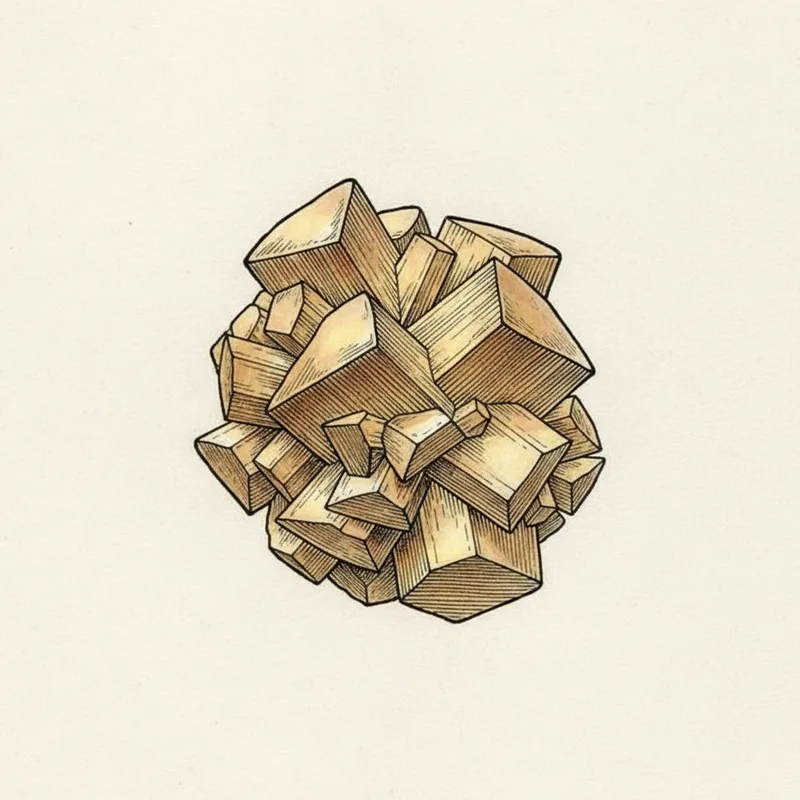
Marcasite
Pyrite's Unstable Twin
Affiliate links. We may earn a commission, at no cost to you.
Quick Facts
Formation & Origin
Marcasite is an iron sulfide mineral (FeS₂) that shares its composition with pyrite but crystallizes in the orthorhombic system, making it a distinct, less stable polymorph. Marcasite has the same chemical formula as pyrite (FeS₂) but crystallizes in a different crystal system (orthorhombic vs. pyrite's cubic). It typically forms at low temperatures in acidic conditions, often in sedimentary environments like chalk, clay, and coal measures.
The crystals frequently grow in distinctive 'cockscomb' or 'spearhead' twin aggregates. These twinned crystals stack together in radiating groups that can look like spiky flowers or sunbursts. Marcasite also forms nodular concretions in chalk and clay, sometimes preserving the shapes of fossils it replaced.
Importantly, marcasite is chemically unstable. Over time, especially in humid conditions, it oxidizes and decomposes into iron sulfate and sulfuric acid, a process called 'pyrite disease' (though it affects marcasite more severely). This is why old marcasite specimens in museum collections sometimes crumble or develop white sulfate crusts.
Identification Guide
Marcasite is paler and more tin-white than pyrite, which has a warmer brass-yellow color. The crystal habit is the key distinguisher: marcasite forms tabular, spearhead-shaped crystals often in cockscomb twins, while pyrite forms cubes, pyritohedra, and octahedra.
Distinguish from pyrite (warmer color, cubic crystals), arsenopyrite (similar color but contains arsenic, different streak), and chalcopyrite (deeper yellow, softer). Note that 'marcasite' jewelry is actually made from cut pyrite, not true marcasite.
Spotting Fakes
The biggest misconception: 'marcasite' jewelry has never actually been made from marcasite. Since the Victorian era, the name has been used in the jewelry trade for faceted pyrite set in silver. True marcasite is too unstable and brittle for jewelry use. If you're buying mineral specimens, the main risk is pyrite being labeled as marcasite. Check crystal habit: cockscomb and spearhead shapes indicate true marcasite.
Some links in this post go to Amazon and Etsy. Crystal Almanac earns a commission from qualifying purchases at no extra cost to you. Tools recommended here are ones we would use ourselves to run the tests described - the recommendation comes first, the link is downstream of it.
Cultural & Metaphysical Traditions
Presented as cultural traditions, not scientific evidence
Marcasite has been associated with the spark of inspiration since ancient times, when it was used alongside flint to create fire. Crystal practitioners connect it with intellectual stimulation, courage, and overcoming stagnation. Its tendency to decompose over time has also made it a symbol of the impermanence of material things.
Metaphysical and “healing” associations are cultural traditions, not medical advice or scientific fact. Crystals are not a substitute for professional medical care.
Where It's Found
Classic cockscomb crystal aggregates
Sun-shaped crystal groups in chalk
Associated with lead-zinc deposits
Historic source for Victorian 'marcasite' jewelry
Price Guide
Good to Know
Scratch test: At hardness 6, Marcasite resists scratching from a knife but can be scratched by quartz. Best for pendants and earrings rather than rings.
Global supply: Found in 4 notable locations worldwide, from France to Czech Republic.
Heft test: Marcasite has a specific gravity of 4.88 - noticeably heavier than quartz. You'll feel the density when you pick it up.
Common Questions
What is the chemical formula of Marcasite?
The chemical formula of Marcasite is FeS₂.
What is Marcasite's Mohs hardness?
Marcasite has a Mohs hardness of 6 on the 1 to 10 Mohs scale, hard enough to scratch glass but softer than quartz.
Is Marcasite a mineral?
Yes. Marcasite is a naturally occurring mineral (Sulfide Mineral) with a definite chemical composition and an ordered crystal structure.
Care & Safety
The water, salt, and sunlight questions people actually ask before cleansing or displaying marcasite, answered from its hardness (Mohs 6) and chemistry (FeS₂).
Can Marcasite go in water?
Not recommended. Chemically unstable iron sulfide. Decomposes in humidity, producing sulfuric acid. Keep as dry as possible.
Can Marcasite go in salt water?
No. Marcasite is the unstable polymorph of FeS₂ and decomposes in mere humidity, producing sulfuric acid. Salt water would accelerate that decay dramatically. Store it dry, ideally with desiccant packets.
Sources & References
The mineralogical and gemological data on this page is drawn from and can be cross-checked against these external references.
- WikipediaMarcasite on Wikipedia
- WebmineralMarcasite mineral data (Webmineral)
- Handbook of MineralogyMarcasite (Handbook of Mineralogy, PDF)
Explore More
Save This Stone

Keep this marcasite reference handy. Save the card to a Pinterest board and the profile is one tap away.
Save to PinterestNewsletter
Something shiny, now and then
A stone worth knowing, or a fake worth spotting, every so often. No spam.