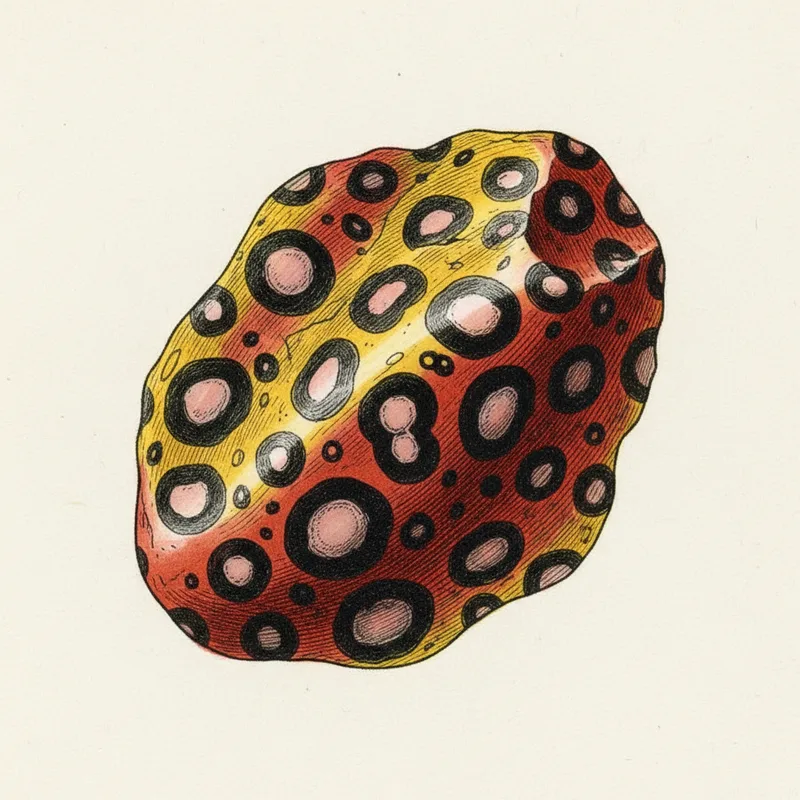
Leopardskin Jasper
The Spotted Totem Stone
Affiliate links. We may earn a commission, at no cost to you.
Quick Facts
Formation & Origin
Leopardskin jasper is an orbicular rhyolite, a silica-rich volcanic rock whose spherulitic spots resemble a leopard's coat. Leopardskin jasper (also called leopard stone or leopard skin rhyolite) is an orbicular variety of jasper or rhyolite displaying circular spotted patterns that resemble a leopard's coat. The spots are formed by spherulitic crystallization, where silica minerals grow radially outward from nucleation points during the slow cooling of silica-rich volcanic flows.
Each 'spot' is a spherulite: a radial aggregate of tiny crystal fibers that grew outward from a central point. Different mineral compositions in the center versus the rim of each spherulite create the contrasting colors. Iron-rich minerals produce the darker spots, while lighter matrices may contain feldspar or silica with less iron.
The trade name 'leopardskin jasper' covers material from several sources and the exact mineralogy varies. Some material is true jasper (microcrystalline quartz), while other pieces are better classified as rhyolite (a volcanic rock). Both share the distinctive spotted pattern.
Identification Guide
Leopardskin jasper is identified by its orbicular spotted pattern: round spots (typically 3-10mm) in tan, brown, red, or pink on a contrasting background. The overall appearance resembles animal print.
Distinguish from dalmatian stone (white background with black spots, different composition), ocean jasper (more colorful, often with druzy), and poppy jasper (red spots in a darker matrix). Leopardskin jasper's warm earth-toned palette on a tan or cream background is characteristic.
Spotting Fakes
Leopardskin jasper is inexpensive and not commonly faked. The main concern is mislabeling: different spotted stones from various localities are sold under the same name. This doesn't affect the stone's quality or beauty but means 'leopardskin jasper' isn't a precisely defined variety. Genuine orbicular patterns are three-dimensional and visible on all cut surfaces.
Some links in this post go to Amazon and Etsy. Crystal Almanac earns a commission from qualifying purchases at no extra cost to you. Tools recommended here are ones we would use ourselves to run the tests described - the recommendation comes first, the link is downstream of it.
Cultural & Metaphysical Traditions
Presented as cultural traditions, not scientific evidence
Leopardskin jasper is associated with animal totems, self-discovery, and balanced confidence. The spotted pattern connects it to the energy of big cats: strength, patience, and knowing when to act. Practitioners use it for building trust in intuition, attracting harmonious relationships, and finding the balance between independence and community.
Metaphysical and “healing” associations are cultural traditions, not medical advice or scientific fact. Crystals are not a substitute for professional medical care.
Where It's Found
Primary commercial source
Some orbicular jasper material
Spotted rhyolite specimens
Price Guide
Good to Know
Scratch test: At hardness 6.5, Leopardskin Jasper resists scratching from a knife but can be scratched by quartz. Best for pendants and earrings rather than rings.
Global supply: Found in 3 notable locations worldwide, from Mexico to Australia.
Heft test: Leopardskin Jasper has average mineral density (2.58-2.91). It feels about as heavy as you'd expect from a stone its size.
Common Questions
What is the chemical formula of Leopardskin Jasper?
The chemical formula of Leopardskin Jasper is SiO₂ (rhyolitic orbicular structure).
What is Leopardskin Jasper's Mohs hardness?
Leopardskin Jasper has a Mohs hardness of 6.5 on the 1 to 10 Mohs scale, hard enough to scratch glass but softer than quartz.
Is Leopardskin Jasper a mineral?
Not quite. Leopardskin Jasper is a rock (a naturally occurring mixture of minerals), not a single mineral species.
Care & Safety
The water, salt, and sunlight questions people actually ask before cleansing or displaying leopardskin jasper, answered from its hardness (Mohs 6.5) and chemistry (SiO₂ (rhyolitic orbicular structure)).
Can Leopardskin Jasper go in water?
Yes. Leopardskin Jasper is not water-soluble and durable enough (Mohs 6.5), so a rinse or a quick wash with mild soap is no problem, cleanse it in water freely if that is your practice. A long soak does nothing for it either way, so skip that, and dry the stone afterward.
Can Leopardskin Jasper go in salt water?
Not recommended, even though leopardskin jasper itself is hard and not water-soluble. Salt is both corrosive and mildly abrasive: it can dull a polished surface, attack metal settings, and crystallize inside small fractures as the stone dries. A quick dip will not destroy leopardskin jasper, but rinse it with fresh water afterward and dry it. For routine cleaning, plain water is the kinder choice.
Sources & References
The mineralogical and gemological data on this page is drawn from and can be cross-checked against these external references.
- WikipediaRhyolite on Wikipedia
Explore More
Save This Stone

Keep this leopardskin jasper reference handy. Save the card to a Pinterest board and the profile is one tap away.
Save to PinterestNewsletter
Something shiny, now and then
A stone worth knowing, or a fake worth spotting, every so often. No spam.