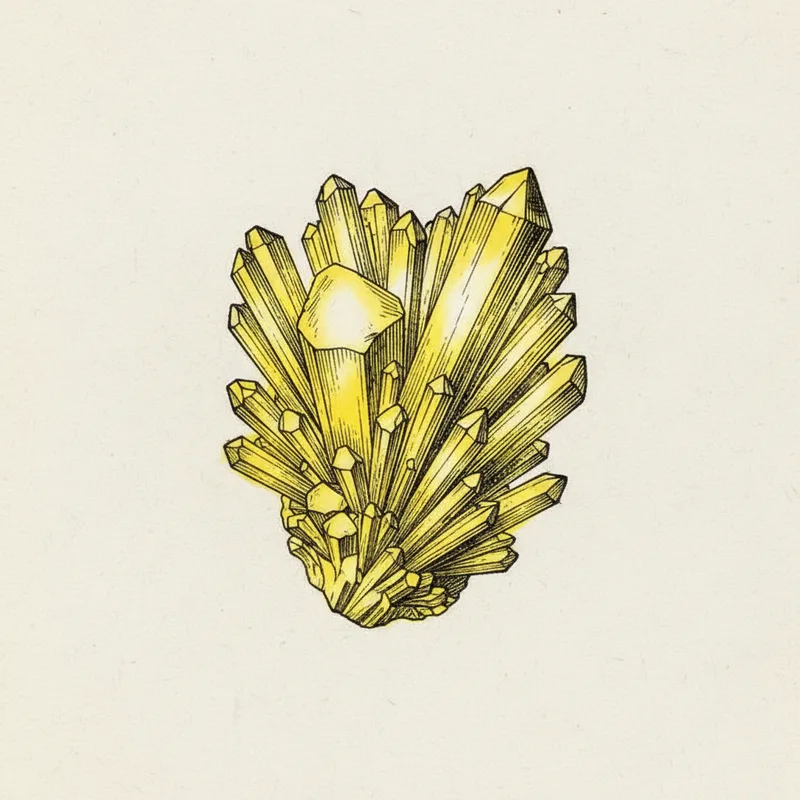
Legrandite
The Electric Yellow Crystal
Affiliate links. We may earn a commission, at no cost to you.
Quick Facts
Formation & Origin
Legrandite is a rare hydrated zinc arsenate mineral (Zn₂(AsO₄)(OH)·H₂O), sought by collectors for its electric lemon-yellow crystals. Legrandite forms as a secondary mineral in the oxidation zone of zinc-arsenic ore deposits, where zinc-rich and arsenic-rich solutions combine under acidic conditions. The crystals precipitate in open cavities within limonite and iron oxide matrix.
The Ojuela Mine in Mapimí, Mexico produces the world's most spectacular legrandite specimens. There, vivid yellow prismatic crystals grow in sprays and clusters within iron-stained limestone cavities. The best specimens feature elongated crystals up to 10cm long with intense, saturated color and brilliant vitreous luster.
Legrandite's intense yellow color comes from the zinc-arsenate chemistry itself rather than from trace elements. This means the vivid color is inherent to the mineral rather than variable, making every well-crystallized legrandite specimen naturally vivid.
Identification Guide
Legrandite is identified by its intense lemon-yellow color, elongated prismatic crystal habit, and association with zinc-arsenic ore deposits. The vitreous luster on crystal faces is particularly bright. Specific gravity of 4.01 makes it noticeably heavier than its appearance suggests.
Distinguish from adamite (can be yellow but more commonly green, different crystal habit), sulfur (softer, melts easily, lower SG), and yellow calcite (softer, effervesces in acid). Legrandite's combination of vivid yellow, high SG, and prismatic habit is distinctive. SAFETY: Contains arsenic. Handle carefully.
Spotting Fakes
Legrandite is not commonly faked because it's a niche collector mineral. The main concern is quality and provenance. Ojuela Mine specimens with large, well-formed crystals are the most valuable. Some specimens may have crystals repaired or reattached, so check crystal attachment points under magnification for glue residue.
Some links in this post go to Amazon and Etsy. Crystal Almanac earns a commission from qualifying purchases at no extra cost to you. Tools recommended here are ones we would use ourselves to run the tests described - the recommendation comes first, the link is downstream of it.
Cultural & Metaphysical Traditions
Presented as cultural traditions, not scientific evidence
Legrandite is associated with joy, optimism, and personal sunshine in crystal healing. Its bright yellow color connects it strongly to solar plexus energy and themes of confidence and warmth. Practitioners use it for lifting spirits and attracting positivity. IMPORTANT: Contains arsenic. Display only. Handle with care and wash hands after.
Metaphysical and “healing” associations are cultural traditions, not medical advice or scientific fact. Crystals are not a substitute for professional medical care.
Where It's Found
World's finest specimens, stunning crystal sprays
Fine crystallized specimens
Minor occurrences
Type locality, originally described from here
Price Guide
Good to Know
Scratch test: At hardness 4.5, Legrandite can be scratched with a copper coin. Handle gently and keep away from harder stones in your collection.
Global supply: Found in 4 notable locations worldwide, from Mexico to Germany.
Heft test: Legrandite has a specific gravity of 4.01 - noticeably heavier than quartz. You'll feel the density when you pick it up.
Common Questions
What is the chemical formula of Legrandite?
The chemical formula of Legrandite is Zn₂(AsO₄)(OH)·H₂O.
What is Legrandite's Mohs hardness?
Legrandite has a Mohs hardness of 4.5 on the 1 to 10 Mohs scale, which a steel knife will scratch.
Is Legrandite a mineral?
Yes. Legrandite is a naturally occurring mineral (Arsenate Mineral) with a definite chemical composition and an ordered crystal structure.
Care & Safety
The water, salt, and sunlight questions people actually ask before cleansing or displaying legrandite, answered from its hardness (Mohs 4.5) and chemistry (Zn₂(AsO₄)(OH)·H₂O).
Can Legrandite go in water?
Not recommended. Legrandite can react with water, draw in moisture, or break down when it gets wet, so skip the rinse. Wipe it with a dry or barely damp cloth and dry it right away. Important: legrandite contains arsenic. Never use it for gem elixirs or crystal-infused water, and wash your hands after handling it.
Can Legrandite go in salt water?
No. Legrandite is best kept away from water altogether, and salt water is the harsher version of that problem: the dissolved salt is corrosive while the stone is wet, then leaves gritty crystals behind in cracks and crevices as it dries.
Sources & References
The mineralogical and gemological data on this page is drawn from and can be cross-checked against these external references.
- WikipediaLegrandite on Wikipedia
- WebmineralLegrandite mineral data (Webmineral)
- Handbook of MineralogyLegrandite (Handbook of Mineralogy, PDF)
Related Minerals
Another zinc arsenate from similar deposits
Zinc arsenate polymorph
Another vivid yellow mineral from oxidation zones
Explore More
Save This Stone

Keep this legrandite reference handy. Save the card to a Pinterest board and the profile is one tap away.
Save to PinterestNewsletter
Something shiny, now and then
A stone worth knowing, or a fake worth spotting, every so often. No spam.