Hematoid Quartz
The Fire Crystal
Affiliate links. We may earn a commission, at no cost to you.
Quick Facts
Formation & Origin
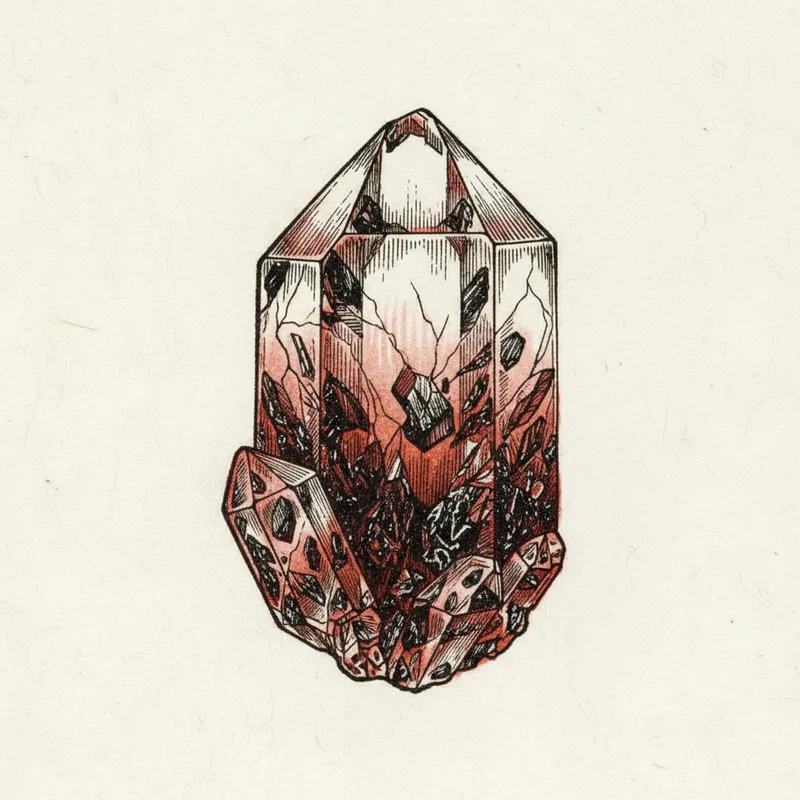
Hematoid quartz (also sold as fire quartz, harlequin quartz, or ferruginous quartz) is clear or milky quartz containing inclusions of hematite (iron oxide). The hematite creates vivid red, orange, or golden zones within or on the surface of the quartz crystal.
The inclusions can appear as red phantom outlines within the crystal (recording earlier stages of crystal growth that were dusted with hematite), as scattered red flecks and streaks, or as a pervasive reddish staining throughout. Each pattern tells a different story about when during the crystal's growth the iron-rich fluids were present.
The name 'hematoid' simply means 'containing hematite.' 'Fire quartz' is a trade name emphasizing the red-orange coloring. 'Harlequin quartz' typically refers to specimens with distinct red spots or streaks on a clear background, creating a patterned appearance.
Identification Guide
Hematoid quartz is identified as quartz (hardness 7, vitreous luster, hexagonal prisms) with visible red-orange hematite inclusions. The inclusions should be clearly iron oxide, visible as red zones, phantoms, or streaks.
Distinguish from strawberry quartz (finer, more evenly distributed pink inclusions from lepidocrocite), tangerine quartz (surface coating rather than internal inclusions), and red jasper (opaque microcrystalline quartz). In hematoid quartz, the clear quartz host and the red hematite inclusions should both be visible.
Spotting Fakes
Some sellers heat-treat low-quality hematoid quartz to intensify the red color. Natural specimens show organic variation in the hematite distribution. Very uniformly red quartz without clear zones may be dyed or heavily treated. Genuine hematoid quartz should show distinct hematite inclusions, not uniform coloring throughout.
Some links in this post go to Amazon and Etsy. Crystal Almanac earns a commission from qualifying purchases at no extra cost to you. Tools recommended here are ones we would use ourselves to run the tests described - the recommendation comes first, the link is downstream of it.
Cultural & Metaphysical Traditions
Presented as cultural traditions, not scientific evidence
Hematoid quartz is considered a powerful combination of quartz's amplifying properties with hematite's grounding energy. The fire imagery connects it to courage, vitality, and passionate action. Practitioners use it for boosting self-esteem, increasing physical energy, and transforming negative patterns into positive ones.
Metaphysical and “healing” associations are cultural traditions, not medical advice or scientific fact. Crystals are not a substitute for professional medical care.
Where It's Found
Primary source for vivid red-included specimens
Good quality specimens
Commercial material
Price Guide
Good to Know
Scratch test: At hardness 7, Hematoid Quartz can scratch glass and steel. It's durable enough for any type of jewelry.
Global supply: Found in 3 notable locations worldwide, from Brazil to China.
Heft test: Hematoid Quartz has average mineral density (2.65). It feels about as heavy as you'd expect from a stone its size.
Common Questions
What is the chemical formula of Hematoid Quartz?
The chemical formula of Hematoid Quartz is SiO₂ (with Fe₂O₃ hematite inclusions).
What is Hematoid Quartz's Mohs hardness?
Hematoid Quartz has a Mohs hardness of 7 on the 1 to 10 Mohs scale, hard enough to scratch glass and stand up to daily wear.
Is Hematoid Quartz a mineral?
Yes. Hematoid Quartz is a naturally occurring mineral (Quartz Family) with a definite chemical composition and an ordered crystal structure.
Care & Safety
The water, salt, and sunlight questions people actually ask before cleansing or displaying hematoid quartz, answered from its hardness (Mohs 7) and chemistry (SiO₂ (with Fe₂O₃ hematite inclusions)).
Can Hematoid Quartz go in water?
Yes. Hematoid Quartz is hard (Mohs 7) and chemically stable, so a rinse or a quick wash with mild soap is no problem, cleanse it in water freely if that is your practice. A long soak does nothing for it either way, so skip that, and dry the stone afterward.
Can Hematoid Quartz go in salt water?
Not recommended, even though hematoid quartz itself is hard and not water-soluble. Salt is both corrosive and mildly abrasive: it can dull a polished surface, attack metal settings, and crystallize inside small fractures as the stone dries. Hematoid Quartz's iron content also makes rust staining likely if salt residue sits on the surface. A quick dip will not destroy hematoid quartz, but rinse it with fresh water afterward and dry it. For routine cleaning, plain water is the kinder choice.
Sources & References
The mineralogical and gemological data on this page is drawn from and can be cross-checked against these external references.
- WikipediaQuartz on Wikipedia
- WebmineralQuartz mineral data (Webmineral)
- Handbook of MineralogyQuartz (Handbook of Mineralogy, PDF)
Explore More
Save This Stone

Keep this hematoid quartz reference handy. Save the card to a Pinterest board and the profile is one tap away.
Save to PinterestNewsletter
Something shiny, now and then
A stone worth knowing, or a fake worth spotting, every so often. No spam.