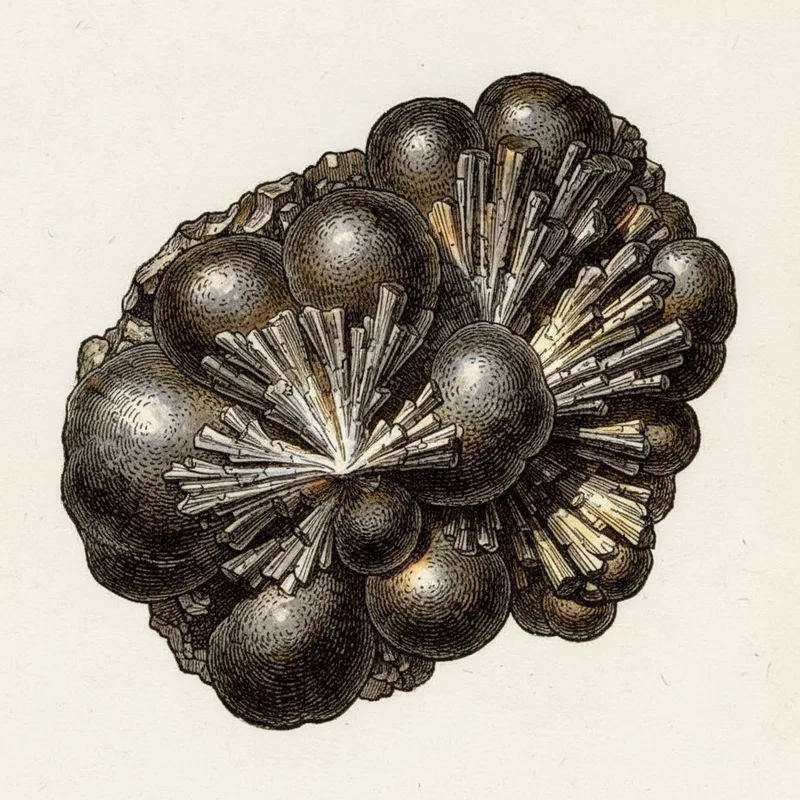
Goethite
The Poet's Iron
Affiliate links. We may earn a commission, at no cost to you.
Quick Facts
Formation & Origin
Goethite is one of the most common iron-bearing minerals on Earth's surface, forming wherever iron-rich rocks weather in the presence of water and oxygen. It's a primary component of rust and the main mineral in limonite (the earthy brown material that stains so many rocks).
Well-crystallized goethite forms prismatic or acicular (needle-like) crystals with brilliant adamantine luster. Botryoidal (grape-like) goethite masses can develop stunning iridescent surfaces where thin-film interference creates rainbow colors on the dark brown base. This iridescent variety is sometimes called 'rainbow goethite.'
The mineral was named after Johann Wolfgang von Goethe, the German poet, novelist, and statesman who was also an avid mineral collector and amateur geologist. Goethe studied color theory and mineralogy extensively, making the naming particularly appropriate for a mineral that displays such varied visual effects.
Identification Guide
Goethite is identified by its yellow-brown streak (diagnostic, distinguishing it from hematite's red streak), brown to dark brown color, and association with weathered iron-bearing rocks. Prismatic crystals have a bright adamantine luster, while massive forms are earthy.
Distinguish from hematite (red streak vs. goethite's yellow-brown), limonite (an aggregate containing goethite rather than a specific mineral), and magnetite (magnetic, black streak). The streak test is the single most useful identification method.
Spotting Fakes
Goethite crystal specimens are not commonly faked. Iridescent botryoidal goethite is distinctive enough that imitation would be difficult. The main caution is that some sellers label any brown iron oxide as goethite when it may be limonite (a mixture of iron hydroxide minerals) or other iron minerals. For specimen collectors, the streak test resolves most confusion.
Some links in this post go to Amazon and Etsy. Crystal Almanac earns a commission from qualifying purchases at no extra cost to you. Tools recommended here are ones we would use ourselves to run the tests described - the recommendation comes first, the link is downstream of it.
Cultural & Metaphysical Traditions
Presented as cultural traditions, not scientific evidence
Goethite is associated with deep emotional processing and accessing grief or loss in crystal healing. Practitioners use it for connecting with the earth's energy and finding strength during difficult transitions. Its rainbow iridescent variety adds associations with hope and finding beauty in darkness. The connection to Goethe adds literary and intellectual associations.
Metaphysical and “healing” associations are cultural traditions, not medical advice or scientific fact. Crystals are not a substitute for professional medical care.
Where It's Found
Classic botryoidal specimens, iridescent surfaces
Excellent crystal specimens
Fine prismatic crystals
Massive deposits in ancient mining region
Price Guide
Good to Know
Scratch test: At hardness 5, Goethite resists scratching from a knife but can be scratched by quartz. Best for pendants and earrings rather than rings.
Global supply: Found in 4 notable locations worldwide, from England to Spain.
Heft test: Goethite has average mineral density (3.3-4.3). It feels about as heavy as you'd expect from a stone its size.
Common Questions
What is the chemical formula of Goethite?
The chemical formula of Goethite is α-FeO(OH).
What is Goethite's Mohs hardness?
Goethite has a Mohs hardness of 5 on the 1 to 10 Mohs scale, which a steel knife will scratch.
Is Goethite a mineral?
Yes. Goethite is a naturally occurring mineral (Oxide/Hydroxide Mineral) with a definite chemical composition and an ordered crystal structure.
Care & Safety
The water, salt, and sunlight questions people actually ask before cleansing or displaying goethite, answered from its hardness (Mohs 5) and chemistry (α-FeO(OH)).
Can Goethite go in water?
Only briefly. A quick rinse under running water is fine for goethite, but do not let it soak or sit submerged. At Mohs 5 it is tough enough for a rinse but not for a long soak. Dry it thoroughly afterward.
Can Goethite go in salt water?
No. Goethite can take a brief fresh-water rinse and nothing more, and salt water is harder on it both ways: corrosive while wet, then abrasive as the salt dries into crystals. Goethite's iron content also makes rust staining likely if salt residue sits on the surface. If it does meet salt water, rinse it with fresh water and dry it promptly.
Sources & References
The mineralogical and gemological data on this page is drawn from and can be cross-checked against these external references.
- WikipediaGoethite on Wikipedia
- WebmineralGoethite mineral data (Webmineral)
- Handbook of MineralogyGoethite (Handbook of Mineralogy, PDF)
Related Minerals
Iron oxide cousin, same iron source
Iron oxyhydroxide polymorph
Another common iron mineral
Explore More
Oxide & Hydroxide Minerals
Leo Season Crystals 2026: Stones for Confidence
Is My Sunstone Real? How to Spot Goldstone Glass
How to Clean Quartz Crystals (Without Ruining Them)
Mohs Hardness Scale
See where Goethite sits on the scale
Crystal Care Guide
Water safety, sunlight, and handling tips
Save This Stone

Keep this goethite reference handy. Save the card to a Pinterest board and the profile is one tap away.
Save to PinterestNewsletter
Something shiny, now and then
A stone worth knowing, or a fake worth spotting, every so often. No spam.