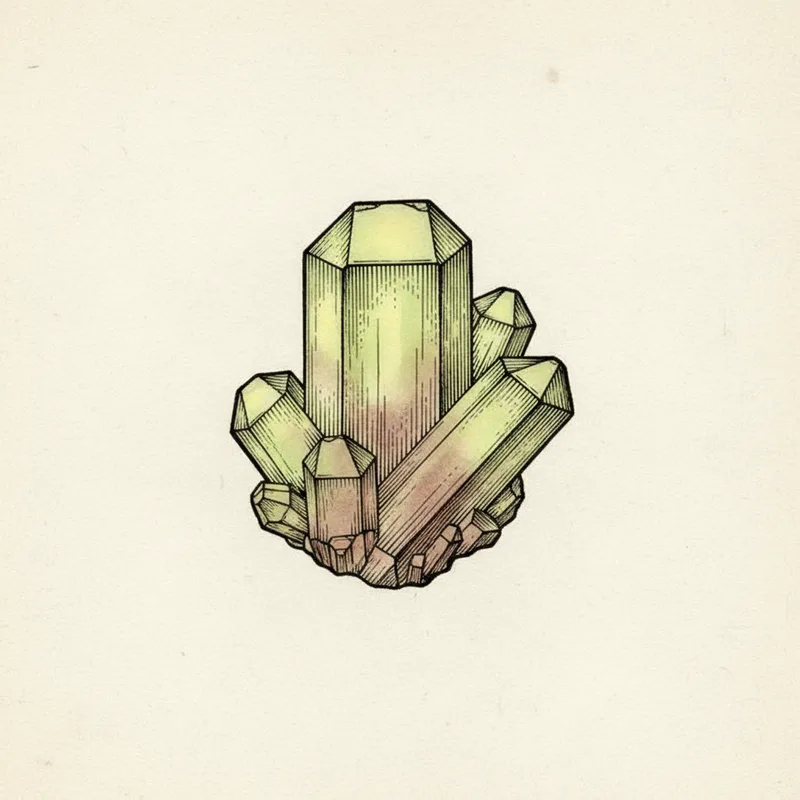
Diaspore
The Color-Change Gem
Affiliate links. We may earn a commission, at no cost to you.
Quick Facts
Formation & Origin
Diaspore is an aluminum oxyhydroxide that forms during the metamorphism of aluminum-rich rocks, particularly bauxite (the ore of aluminum) and emery deposits. Most diaspore is opaque and unremarkable, but a unique deposit in Turkey's Ilbir Mountains produces transparent, gem-quality crystals.
The Turkish gem diaspore is remarkable for its alexandrite-like color change: champagne or kiwi green in daylight shifts to pinkish-red under incandescent light. This effect comes from trace amounts of manganese that absorb different wavelengths depending on the light source's spectral composition.
The gem material has been marketed under trade names including 'Zultanite' (trademarked by one mining company), 'Csarite' (another trade name), and simply 'color-change diaspore.' All refer to the same material from the same Turkish deposit. The mine is small and production is limited, making this genuinely rare gem material.
Identification Guide
Gem diaspore is identified by its color-change effect (green/champagne to pink/red), hardness 7, orthorhombic crystal system, and high specific gravity (3.30-3.50). The color change under different light sources is the most dramatic identifier.
Distinguish from alexandrite (much higher RI, different SG), color-change garnet (isometric), and color-change sapphire (trigonal, higher RI). Diaspore has a perfect cleavage in one direction, which can be visible in faceted stones.
Spotting Fakes
Synthetic color-change corundum (alexandrite simulant) is sometimes sold as diaspore/Zultanite. Genuine diaspore has specific RI (1.702-1.750) and SG (3.30-3.50) ranges that differ from corundum. Lab reports from GIA or similar labs can confirm identity. The color change in genuine diaspore is typically more subtle than in alexandrite, shifting between champagne/green and pink rather than dramatic green-to-red.
Some links in this post go to Amazon and Etsy. Crystal Almanac earns a commission from qualifying purchases at no extra cost to you. Tools recommended here are ones we would use ourselves to run the tests described - the recommendation comes first, the link is downstream of it.
Cultural & Metaphysical Traditions
Presented as cultural traditions, not scientific evidence
Diaspore is a relatively recent addition to crystal healing traditions, having only entered the gem market in the 2000s. Practitioners associate its color-change ability with adaptability, seeing situations from multiple perspectives, and finding beauty in transitions. The Turkish origin adds associations with the crossroads between East and West.
Metaphysical and “healing” associations are cultural traditions, not medical advice or scientific fact. Crystals are not a substitute for professional medical care.
Where It's Found
Only significant gem source, marketed as 'Zultanite' and 'Csarite'
Small crystals, collector specimens
Type locality, non-gem material
Price Guide
Good to Know
Scratch test: At hardness 7, Diaspore can scratch glass and steel. It's durable enough for any type of jewelry.
Global supply: Found in 3 notable locations worldwide, from Turkey to United States.
Heft test: Diaspore has average mineral density (3.30-3.50). It feels about as heavy as you'd expect from a stone its size.
Common Questions
What is the chemical formula of Diaspore?
The chemical formula of Diaspore is AlO(OH).
What is Diaspore's Mohs hardness?
Diaspore has a Mohs hardness of 7 on the 1 to 10 Mohs scale, hard enough to scratch glass and stand up to daily wear.
Is Diaspore a mineral?
Yes. Diaspore is a naturally occurring mineral (Oxide/Hydroxide Mineral) with a definite chemical composition and an ordered crystal structure.
Care & Safety
The water, salt, and sunlight questions people actually ask before cleansing or displaying diaspore, answered from its hardness (Mohs 7) and chemistry (AlO(OH)).
Can Diaspore go in water?
Yes. Diaspore is hard (Mohs 7) and chemically stable, so a rinse or a quick wash with mild soap is no problem, cleanse it in water freely if that is your practice. A long soak does nothing for it either way, so skip that, and dry the stone afterward.
Can Diaspore go in salt water?
Not recommended, even though diaspore itself is hard and not water-soluble. Salt is both corrosive and mildly abrasive: it can dull a polished surface, attack metal settings, and crystallize inside small fractures as the stone dries. A quick dip will not destroy diaspore, but rinse it with fresh water afterward and dry it. For routine cleaning, plain water is the kinder choice.
Sources & References
The mineralogical and gemological data on this page is drawn from and can be cross-checked against these external references.
- WikipediaDiaspore on Wikipedia
- WebmineralDiaspore mineral data (Webmineral)
- Handbook of MineralogyDiaspore (Handbook of Mineralogy, PDF)
Related Minerals
More famous color-change gem, different mineral
Polymorph with same chemistry, different structure
Related aluminum hydroxide mineral
Explore More
Save This Stone
%20is%20sometimes%20sold%20as%20diaspore%2FZultanite.%20Meaning%2C%20properties%20%26%20how%20to%20spot%20fakes%20at%20Crystal%20Almanac.)
Keep this diaspore reference handy. Save the card to a Pinterest board and the profile is one tap away.
Save to PinterestNewsletter
Something shiny, now and then
A stone worth knowing, or a fake worth spotting, every so often. No spam.