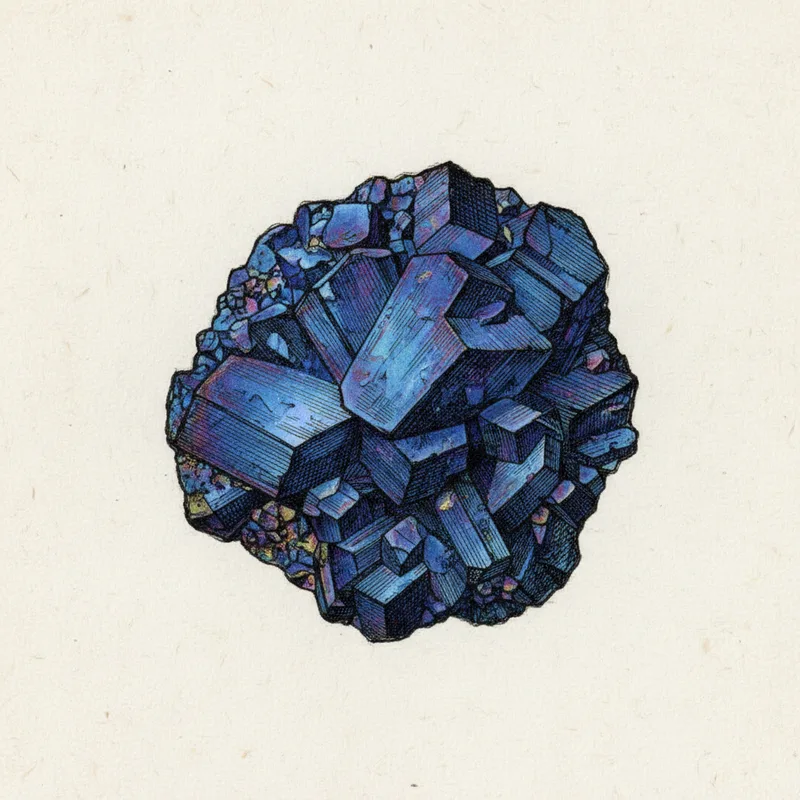
Covellite
The Indigo Copper
Affiliate links. We may earn a commission, at no cost to you.
Quick Facts
Formation & Origin
Covellite is a copper sulfide mineral that forms in the secondary enrichment zone of copper ore deposits, where surface weathering processes concentrate copper from dispersed primary ores. Copper-bearing solutions percolating downward through oxidized rock encounter a reducing environment and precipitate covellite.
The mineral's stunning indigo blue color with iridescent purple and gold flashes makes it one of the most visually striking copper minerals. The iridescence comes from thin-film interference on its perfect basal cleavage surfaces. Freshly exposed surfaces flash with electric blue, purple, and gold colors.
Covellite was named after Niccolo Covelli, the Italian mineralogist who first described it from Vesuvius in the 1820s. Despite its beauty, it's extremely soft (Mohs 1.5) and has perfect cleavage, making it fragile and impractical for jewelry in its natural state.
Identification Guide
Covellite is identified by its deep indigo blue color with iridescent purple-gold flashes on cleavage surfaces. Its extreme softness (1.5), platy hexagonal crystal habit, and association with other copper minerals are diagnostic.
Distinguish from bornite/peacock ore (harder, different streak), chalcopyrite (brass-yellow base color), and azurite (harder, lighter blue, carbonate). Covellite's combination of deep indigo with iridescence and extreme softness is unique.
Spotting Fakes
Covellite is not commonly faked, though its iridescent quality sometimes leads to confusion with treated or acid-washed peacock ore (bornite/chalcopyrite). Natural covellite is much softer than peacock ore and has a distinctly deeper, more indigo base color. The iridescence should be visible on fresh cleavage surfaces rather than just on outer coatings.
Some links in this post go to Amazon and Etsy. Crystal Almanac earns a commission from qualifying purchases at no extra cost to you. Tools recommended here are ones we would use ourselves to run the tests described - the recommendation comes first, the link is downstream of it.
Cultural & Metaphysical Traditions
Presented as cultural traditions, not scientific evidence
Covellite is associated with inner vision, dreamwork, and spiritual growth. Its deep indigo color connects it strongly to the third eye chakra. Practitioners use it for lucid dreaming, past-life exploration, and accessing hidden knowledge. The iridescent flashes are interpreted as glimpses of other dimensional realities.
Metaphysical and “healing” associations are cultural traditions, not medical advice or scientific fact. Crystals are not a substitute for professional medical care.
Where It's Found
Classic massive specimens from copper mines
Type locality, named after Niccolo Covelli
Good crystal specimens
Parys Mountain copper deposits
Price Guide
Good to Know
Scratch test: At hardness 1.5, Covellite can be scratched with a fingernail. This is a display specimen, not a wearable stone.
Global supply: Found in 4 notable locations worldwide, from United States to Wales.
Heft test: Covellite has a specific gravity of 4.68 - noticeably heavier than quartz. You'll feel the density when you pick it up.
Common Questions
What is the chemical formula of Covellite?
The chemical formula of Covellite is CuS.
What is Covellite's Mohs hardness?
Covellite has a Mohs hardness of 1.5 on the 1 to 10 Mohs scale, soft enough to scratch with a fingernail.
Is Covellite a mineral?
Yes. Covellite is a naturally occurring mineral (Sulfide Mineral) with a definite chemical composition and an ordered crystal structure.
Care & Safety
The water, salt, and sunlight questions people actually ask before cleansing or displaying covellite, answered from its hardness (Mohs 1.5) and chemistry (CuS).
Can Covellite go in water?
Not recommended. At Mohs 1.5, covellite is soft enough that water can slowly dull, etch, or wear down the surface, so a water cleanse does more harm than good here. Reach for a dry cloth instead.
Can Covellite go in salt water?
No. Covellite is best kept away from water altogether, and salt water is the harsher version of that problem: the dissolved salt is corrosive while the stone is wet, then leaves gritty crystals behind in cracks and crevices as it dries. Salt also accelerates corrosion of copper-bearing minerals like covellite.
Sources & References
The mineralogical and gemological data on this page is drawn from and can be cross-checked against these external references.
- WikipediaCovellite on Wikipedia
- WebmineralCovellite mineral data (Webmineral)
- Handbook of MineralogyCovellite (Handbook of Mineralogy, PDF)
Related Minerals
Another copper sulfide from enrichment zones
Iridescent copper mineral, often confused
Blue copper mineral, different chemistry (carbonate)
Explore More
Save This Stone

Keep this covellite reference handy. Save the card to a Pinterest board and the profile is one tap away.
Save to PinterestNewsletter
Something shiny, now and then
A stone worth knowing, or a fake worth spotting, every so often. No spam.