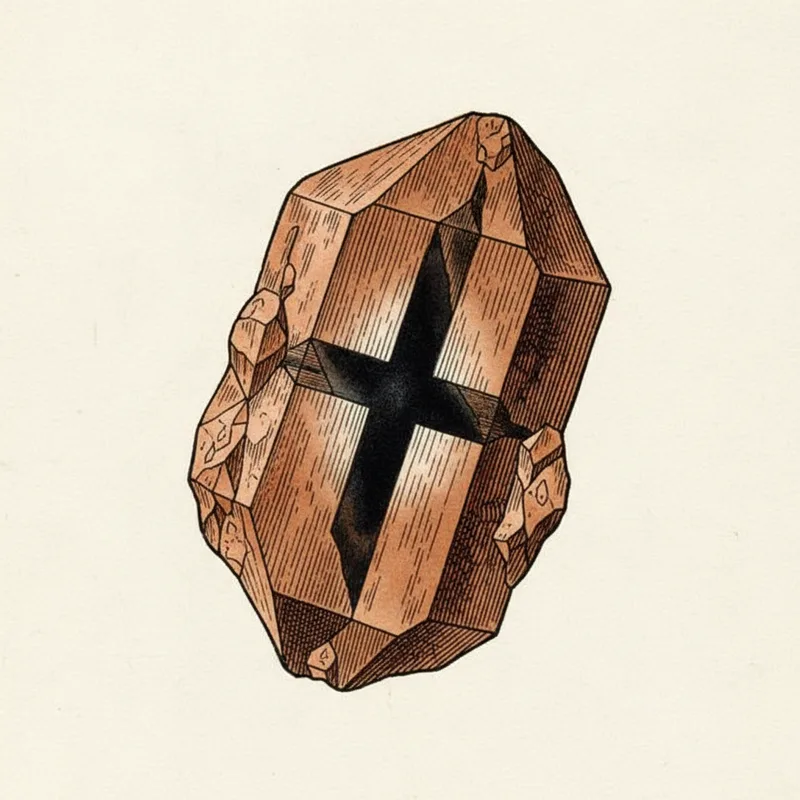
Chiastolite
The Cross Stone
Affiliate links. We may earn a commission, at no cost to you.
Quick Facts
Formation & Origin
Chiastolite is a variety of andalusite that contains carbonaceous (graphite-like) inclusions arranged in a distinctive cross pattern when viewed in cross-section. The name comes from the Greek 'chiastos' (cross-marked).
The cross pattern forms during crystal growth in carbon-rich metamorphic rocks. As the andalusite crystal grows, it pushes aside carbonaceous material in the surrounding mud or shale. This dark material accumulates along specific crystallographic planes within the growing crystal, creating a cross-shaped pattern that runs the length of the prismatic crystal. When sliced perpendicular to the long axis, the carbon-rich planes appear as a dark cross on a lighter background.
Medieval pilgrims on the Camino de Santiago collected chiastolite near Santiago de Compostela, Spain, believing the natural cross was a sign from God. They carried the stones as talismans for protection on their journey.
Identification Guide
Chiastolite is unmistakable when sliced to reveal the cross: a dark cross pattern on a lighter brown or gray background. The cross should extend consistently through the crystal, visible on both ends of a sliced piece.
Distinguish from staurolite (which forms actual cross-shaped twin crystals rather than an internal cross pattern), and painted or carved stones (the cross in chiastolite extends completely through the stone). If the cross only appears on the surface, it's not genuine.
Spotting Fakes
Some sellers paint or carve cross patterns onto ordinary brown stones and sell them as chiastolite. In genuine chiastolite, the cross pattern penetrates completely through the stone and is visible on both cut faces. The carbonaceous inclusions have a slightly different texture than the surrounding mineral. Under magnification, the dark arms of the cross should show fine-grained carbon rather than paint. Slicing through the stone at any point along its length should reveal the cross.
Some links in this post go to Amazon and Etsy. Crystal Almanac earns a commission from qualifying purchases at no extra cost to you. Tools recommended here are ones we would use ourselves to run the tests described - the recommendation comes first, the link is downstream of it.
Cultural & Metaphysical Traditions
Presented as cultural traditions, not scientific evidence
The natural cross pattern has made chiastolite a powerful symbol in Christian, pre-Christian, and modern crystal healing traditions. Medieval pilgrims used it as a protective amulet. Modern practitioners associate it with harmony, balance, and the integration of opposing forces. The cross is interpreted as representing the intersection of the physical and spiritual worlds.
Metaphysical and “healing” associations are cultural traditions, not medical advice or scientific fact. Crystals are not a substitute for professional medical care.
Where It's Found
Major commercial source
Historic pilgrimage connection
Fine cross-section specimens
Good quality material
Price Guide
Good to Know
Scratch test: At hardness 7.5, Chiastolite can scratch glass and steel. It's durable enough for any type of jewelry.
Global supply: Found in 4 notable locations worldwide, from China to Russia.
Heft test: Chiastolite has average mineral density (3.13-3.17). It feels about as heavy as you'd expect from a stone its size.
Common Questions
What is the chemical formula of Chiastolite?
The chemical formula of Chiastolite is Al₂SiO₅ (variety of andalusite).
What is Chiastolite's Mohs hardness?
Chiastolite has a Mohs hardness of 7.5 on the 1 to 10 Mohs scale, hard enough to scratch glass and stand up to daily wear.
Is Chiastolite a mineral?
Yes. Chiastolite is a naturally occurring mineral (Silicate Mineral (Nesosilicate)) with a definite chemical composition and an ordered crystal structure.
Care & Safety
The water, salt, and sunlight questions people actually ask before cleansing or displaying chiastolite, answered from its hardness (Mohs 7.5) and chemistry (Al₂SiO₅ (variety of andalusite)).
Can Chiastolite go in water?
Yes. Chiastolite is hard (Mohs 7.5) and chemically stable, so a rinse or a quick wash with mild soap is no problem, cleanse it in water freely if that is your practice. A long soak does nothing for it either way, so skip that, and dry the stone afterward.
Can Chiastolite go in salt water?
Not recommended, even though chiastolite itself is hard and not water-soluble. Salt is both corrosive and mildly abrasive: it can dull a polished surface, attack metal settings, and crystallize inside small fractures as the stone dries. A quick dip will not destroy chiastolite, but rinse it with fresh water afterward and dry it. For routine cleaning, plain water is the kinder choice.
Sources & References
The mineralogical and gemological data on this page is drawn from and can be cross-checked against these external references.
- WikipediaChiastolite on Wikipedia
- WebmineralAndalusite mineral data (Webmineral)
- Handbook of MineralogyAndalusite (Handbook of Mineralogy, PDF)
Explore More
Save This Stone

Keep this chiastolite reference handy. Save the card to a Pinterest board and the profile is one tap away.
Save to PinterestNewsletter
Something shiny, now and then
A stone worth knowing, or a fake worth spotting, every so often. No spam.