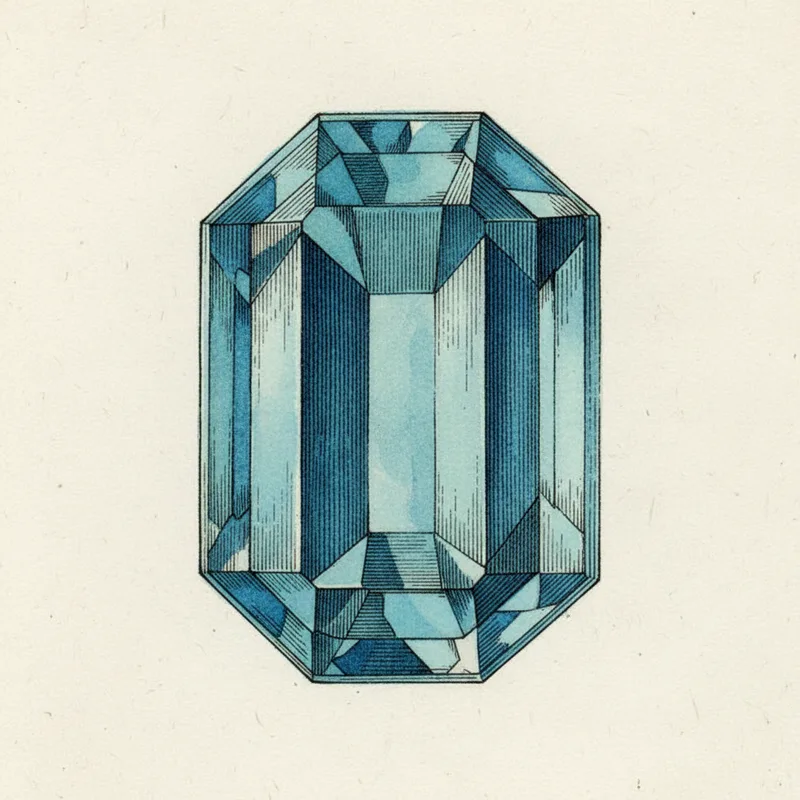
Blue Topaz
The Engineered Ice
Affiliate links. We may earn a commission, at no cost to you.
Quick Facts
Formation & Origin
Blue topaz is the blue color variety of topaz, an aluminum fluorosilicate (Al₂SiO₄(F,OH)₂); most material sold is colorless topaz turned blue by irradiation and heating. Here's an open secret of the gem industry: virtually all blue topaz on the market is created by irradiating and heating colorless topaz. Natural blue topaz exists but is almost always very pale and relatively rare.
The treatment process works in stages. Colorless topaz (abundant and inexpensive) is exposed to radiation in a nuclear reactor or linear accelerator, which creates color centers that turn the stone brown or grayish. Heat treatment then shifts these color centers to produce blue. Different radiation doses and temperatures produce different shades: Sky Blue (lightest), Swiss Blue (medium, vivid), and London Blue (deepest, slightly grayish).
This treatment is permanent, stable, and universally accepted in the gem trade. The resulting stones are genuine topaz with genuine color centers. They're simply assisted versions of the same processes that create the rare natural blue specimens. Natural blue topaz from Texas or Nigeria achieves its color through natural radiation exposure over geological time.
Identification Guide
Blue topaz is identified by its blue color, high hardness (8), orthorhombic crystal system, perfect basal cleavage, and characteristic RI of 1.619-1.627. Treated blue topaz is indistinguishable from natural by standard gemological testing.
Distinguish from aquamarine (lower RI, hexagonal), blue zircon (higher RI, tetragonal, strong doubling), and blue glass (no cleavage, lower hardness). The combination of hardness 8, perfect cleavage, and the specific RI range confirms topaz.
Spotting Fakes
Blue topaz itself is affordable enough that direct fakes are rare. Blue glass or synthetic spinel might be sold as topaz at very low price points. The main consumer concern is understanding that the blue color is treated, not natural. Reputable dealers disclose this. Natural blue topaz (untreated) is significantly more expensive and is typically a very pale sky blue rather than the vivid Swiss or deep London blue. If a dealer claims untreated vivid blue topaz, be skeptical.
Some links in this post go to Amazon and Etsy. Crystal Almanac earns a commission from qualifying purchases at no extra cost to you. Tools recommended here are ones we would use ourselves to run the tests described - the recommendation comes first, the link is downstream of it.
Cultural & Metaphysical Traditions
Presented as cultural traditions, not scientific evidence
Blue topaz is associated with clear communication, insight, and calm analytical thinking. Sky Blue connects to gentle expression, Swiss Blue to confident communication, and London Blue to deep wisdom. Despite being treated, blue topaz has developed its own metaphysical tradition separate from natural (imperial) topaz. Some practitioners distinguish between natural and treated topaz energetically.
Metaphysical and “healing” associations are cultural traditions, not medical advice or scientific fact. Crystals are not a substitute for professional medical care.
Where It's Found
Primary source of raw colorless topaz for treatment
Natural pale blue topaz occurs here
Some naturally blue topaz
Natural pale blue topaz from Mason County
Price Guide
Good to Know
Scratch test: At hardness 8, Blue Topaz can scratch glass and steel. It's durable enough for any type of jewelry.
Global supply: Found in 4 notable locations worldwide, from Brazil to United States.
Heft test: Blue Topaz has average mineral density (3.49-3.57). It feels about as heavy as you'd expect from a stone its size.
Common Questions
What is the chemical formula of Blue Topaz?
The chemical formula of Blue Topaz is Al₂SiO₄(F,OH)₂ (irradiated and heated).
What is Blue Topaz's Mohs hardness?
Blue Topaz has a Mohs hardness of 8 on the 1 to 10 Mohs scale, hard enough to scratch glass and stand up to daily wear.
Is Blue Topaz a mineral?
Yes. Blue Topaz is a naturally occurring mineral (Silicate Mineral (Nesosilicate)) with a definite chemical composition and an ordered crystal structure.
Care & Safety
The water, salt, and sunlight questions people actually ask before cleansing or displaying blue topaz, answered from its hardness (Mohs 8) and chemistry (Al₂SiO₄(F,OH)₂ (irradiated and heated)).
Can Blue Topaz go in water?
Yes. Blue Topaz is hard (Mohs 8) and chemically stable, so a rinse or a quick wash with mild soap is no problem, cleanse it in water freely if that is your practice. A long soak does nothing for it either way, so skip that, and dry the stone afterward.
Can Blue Topaz go in salt water?
Not recommended, even though blue topaz itself is hard and not water-soluble. Salt is both corrosive and mildly abrasive: it can dull a polished surface, attack metal settings, and crystallize inside small fractures as the stone dries. A quick dip will not destroy blue topaz, but rinse it with fresh water afterward and dry it. For routine cleaning, plain water is the kinder choice.
Is sunlight safe for Blue Topaz?
Yes for light. GIA rates topaz color as generally stable to light, and its fading caution applies to the yellow to brown range, not blue. The real risk is thermal: high heat or a sudden temperature change can cause internal breaks, because topaz cleaves easily. Steady room temperature matters more than shade.
Sources & References
The mineralogical and gemological data on this page is drawn from and can be cross-checked against these external references.
- WikipediaTopaz on Wikipedia
- WebmineralTopaz mineral data (Webmineral)
- Handbook of MineralogyTopaz (Handbook of Mineralogy, PDF)
- GIABlue Topaz in the GIA Gem Encyclopedia
Explore More
Other Silicates & Gems
The Communication Collection
Hard, durable, and clear. The three shades (Sky, Swiss, London) map to gentle expression, confident communication, and deep wisdom. Its clarity symbolizes transparent, honest speech.
Scorpio Season Crystals 2026: Stones for Transformation
Expensive-Looking Crystals You Can Actually Afford
Citrine vs Yellow Topaz: How to Tell Them Apart
Mohs Hardness Scale
See where Blue Topaz sits on the scale
Crystal Care Guide
Water safety, sunlight, and handling tips
Save This Stone

Keep this blue topaz reference handy. Save the card to a Pinterest board and the profile is one tap away.
Save to PinterestNewsletter
Something shiny, now and then
A stone worth knowing, or a fake worth spotting, every so often. No spam.