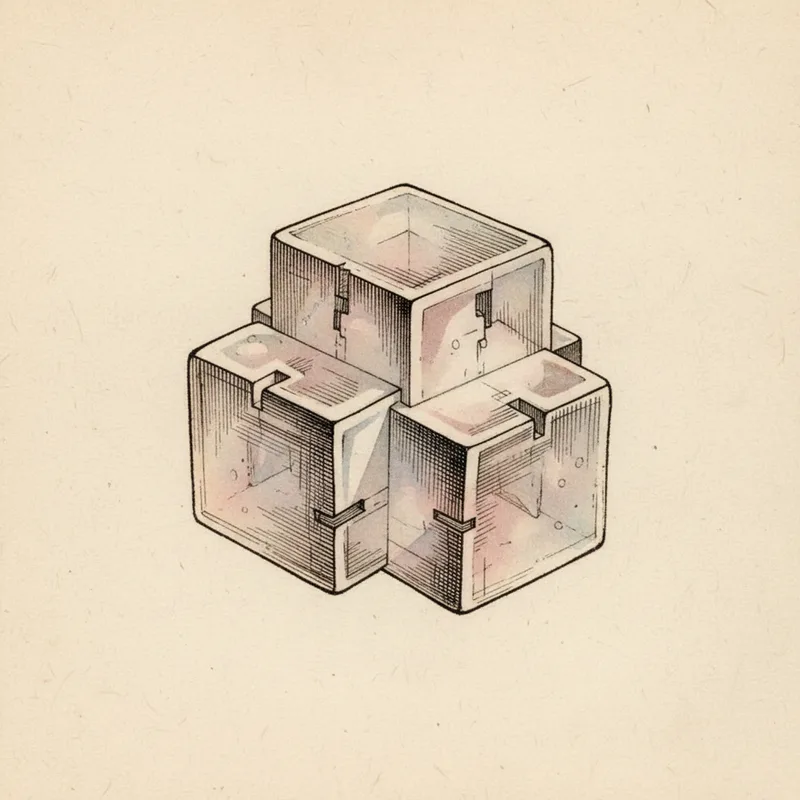
Blue Halite
The Irradiated Salt Crystal
Affiliate links. We may earn a commission, at no cost to you.
Quick Facts
Formation & Origin
Blue halite is simply rock salt (sodium chloride, the same chemical in your kitchen salt shaker) that has turned blue through natural radiation exposure over geological time. Potassium-40, a naturally radioactive isotope present in neighboring sylvite (potassium chloride) deposits, bombards the sodium chloride with radiation over millions of years.
This radiation displaces chloride ions from their lattice positions, creating 'color centers' (F-centers) that absorb red and yellow light, transmitting blue. The intensity of blue depends on the radiation dose and exposure time. The deepest indigo specimens have been irradiated for the longest periods.
Blue halite is rare because it requires very specific conditions: pure halite in close proximity to potassium-bearing minerals, undisturbed for millions of years. It dissolves instantly in water like any salt crystal, so it can only survive in arid underground environments.
Identification Guide
Blue halite is identified by its vivid blue color, perfect cubic cleavage, salty taste (the classic but destructive field test for halite), and extreme softness (Mohs 2.5). It dissolves readily in water.
Distinguish from celestite (harder, different cleavage), blue fluorite (harder, different SG), and sodalite (much harder, opaque). The cubic crystal form, low hardness, and water solubility make halite unmistakable.
Spotting Fakes
Dyed clear halite is sometimes sold as natural blue halite. Natural blue halite has color that penetrates uniformly through the crystal, while dyed specimens show color concentrated on surfaces and in fractures. Under magnification, natural blue halite may show color zoning related to crystal growth planes. Some 'blue Persian salt' sold as gourmet cooking salt is genuine blue halite, though culinary grades are typically less vivid than display specimens.
Some links in this post go to Amazon and Etsy. Crystal Almanac earns a commission from qualifying purchases at no extra cost to you. Tools recommended here are ones we would use ourselves to run the tests described - the recommendation comes first, the link is downstream of it.
Cultural & Metaphysical Traditions
Presented as cultural traditions, not scientific evidence
Blue halite is associated with clarity, mystical vision, and purification in crystal healing. Its rarity and unusual formation process (natural radiation creating beauty from ordinary salt) connects it to themes of transformation. Practitioners use it for meditation and clearing mental fog. IMPORTANT: Dissolves in water. Never cleanse with liquid. Store in a dry environment away from humidity.
Metaphysical and “healing” associations are cultural traditions, not medical advice or scientific fact. Crystals are not a substitute for professional medical care.
Where It's Found
Classic European salt deposits
Fine blue cubic crystals
Deep salt deposits
Some commercial specimens
Price Guide
Good to Know
Scratch test: At hardness 2.5, Blue Halite can be scratched with a fingernail. This is a display specimen, not a wearable stone.
Global supply: Found in 4 notable locations worldwide, from Germany to Iran.
Heft test: With a specific gravity of 2.17, Blue Halite feels lighter than most minerals. This lightness can help identify it.
Common Questions
What is the chemical formula of Blue Halite?
The chemical formula of Blue Halite is NaCl (with radiation-induced color centers).
What is Blue Halite's Mohs hardness?
Blue Halite has a Mohs hardness of 2.5 on the 1 to 10 Mohs scale, soft enough to scratch with a fingernail.
Is Blue Halite a mineral?
Yes. Blue Halite is a naturally occurring mineral (Halide Mineral) with a definite chemical composition and an ordered crystal structure.
Care & Safety
The water, salt, and sunlight questions people actually ask before cleansing or displaying blue halite, answered from its hardness (Mohs 2.5) and chemistry (NaCl (with radiation-induced color centers)).
Can Blue Halite go in water?
No, never. Halite is literally rock salt (NaCl). It dissolves completely in water.
Can Blue Halite go in salt water?
No, never. Blue halite IS salt: rock salt (NaCl) colored by lattice defects. Salt water dissolves it exactly as fresh water does. Keep it completely dry, ideally stored with desiccant.
Sources & References
The mineralogical and gemological data on this page is drawn from and can be cross-checked against these external references.
- WikipediaHalite on Wikipedia
Related Minerals
Same mineral, blue halite is the irradiated variety
Potassium chloride that provides the radiation source
Another mineral colored by radiation-induced F-centers
Explore More
Save This Stone

Keep this blue halite reference handy. Save the card to a Pinterest board and the profile is one tap away.
Save to PinterestNewsletter
Something shiny, now and then
A stone worth knowing, or a fake worth spotting, every so often. No spam.