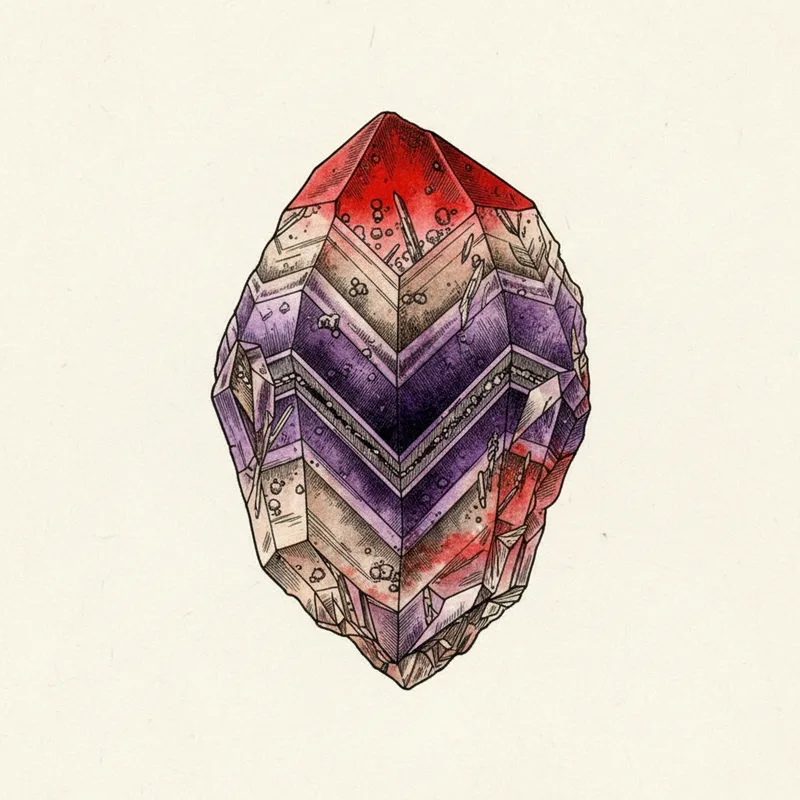
Auralite 23
The Billion-Year Crystal
Affiliate links. We may earn a commission, at no cost to you.
Quick Facts
Formation & Origin
Auralite 23 is a variety of amethyst or chevron amethyst found exclusively in a single mine near Thunder Bay, Ontario, Canada. The crystals are approximately 1.2 billion years old, making them among the oldest amethyst specimens known.
What makes Auralite 23 distinctive is the claimed presence of up to 23 different mineral inclusions within a single crystal. These can include titanite, cacoxenite, lepidocrocite, ajoite, hematite, magnetite, pyrite, goethite, pyrolusite, gold, silver, platinum, nickel, copper, iron, limonite, sphalerite, covellite, chalcopyrite, gialite, epidote, bornite, and rutile. Not every specimen contains all 23, and the specific mineral count in any given crystal varies.
The marketing name 'Auralite 23' was coined by the mine operators. Mineralogically, the base crystal is amethyst or chevron amethyst with various metallic and non-metallic inclusions. The ancient age and complex inclusion suite are genuine, even if the specific '23 minerals' claim is debated by some geologists.
Identification Guide
Auralite 23 resembles chevron amethyst with additional metallic inclusions, red-brown hematite spots, and sometimes visible metallic flecks. The purple coloring ranges from deep violet to pale lavender, often with clear quartz zones and red-brown banding.
Distinguish from standard chevron amethyst (lacks the complex inclusion suite), super seven (different locality and inclusion set), and cacoxenite in amethyst (may overlap but different source). Genuine Auralite 23 comes exclusively from the Thunder Bay deposit.
Spotting Fakes
Since Auralite 23 comes from a single source, provenance is everything. Standard amethyst or chevron amethyst from other localities is sometimes relabeled as Auralite 23. Look for the characteristic red-brown inclusions and complex internal features. Very clean, uniformly purple specimens without visible inclusions are likely regular amethyst. Reputable sellers can trace their supply chain to the Thunder Bay mine.
Some links in this post go to Amazon and Etsy. Crystal Almanac earns a commission from qualifying purchases at no extra cost to you. Tools recommended here are ones we would use ourselves to run the tests described - the recommendation comes first, the link is downstream of it.
Cultural & Metaphysical Traditions
Presented as cultural traditions, not scientific evidence
Auralite 23 has developed a significant following in the crystal healing community since its introduction around 2007. Practitioners associate it with deep meditation, spiritual awakening, and connection to the higher self. The extreme age (1.2 billion years) and complex mineral composition are seen as encoding ancient Earth wisdom. Some practitioners report strong energetic experiences when first handling Auralite 23.
Metaphysical and “healing” associations are cultural traditions, not medical advice or scientific fact. Crystals are not a substitute for professional medical care.
Where It's Found
Only known source, 1.2 billion years old
Price Guide
Good to Know
Scratch test: At hardness 7, Auralite 23 can scratch glass and steel. It's durable enough for any type of jewelry.
Global supply: Found at only one location on Earth - Canada. Supply is inherently limited.
Heft test: Auralite 23 has average mineral density (2.65). It feels about as heavy as you'd expect from a stone its size.
Common Questions
What is the chemical formula of Auralite 23?
The chemical formula of Auralite 23 is SiO₂ (with up to 23 mineral inclusions).
What is Auralite 23's Mohs hardness?
Auralite 23 has a Mohs hardness of 7 on the 1 to 10 Mohs scale, hard enough to scratch glass and stand up to daily wear.
Is Auralite 23 a mineral?
Not a single mineral. Auralite 23 is a mixture of more than one mineral rather than one mineral species.
Care & Safety
The water, salt, and sunlight questions people actually ask before cleansing or displaying auralite 23, answered from its hardness (Mohs 7) and chemistry (SiO₂ (with up to 23 mineral inclusions)).
Can Auralite 23 go in water?
Yes. Auralite 23 is hard (Mohs 7) and chemically stable, so a rinse or a quick wash with mild soap is no problem, cleanse it in water freely if that is your practice. A long soak does nothing for it either way, so skip that, and dry the stone afterward.
Can Auralite 23 go in salt water?
Not recommended, even though auralite 23 itself is hard and not water-soluble. Salt is both corrosive and mildly abrasive: it can dull a polished surface, attack metal settings, and crystallize inside small fractures as the stone dries. A quick dip will not destroy auralite 23, but rinse it with fresh water afterward and dry it. For routine cleaning, plain water is the kinder choice.
Sources & References
The mineralogical and gemological data on this page is drawn from and can be cross-checked against these external references.
- WikipediaQuartz on Wikipedia
- WebmineralQuartz mineral data (Webmineral)
- Handbook of MineralogyQuartz (Handbook of Mineralogy, PDF)
Related Minerals
Base mineral, Auralite 23 is an included variety
Another multi-mineral amethyst variety
One of the inclusion minerals
Explore More
Quartz & Chalcedony
The Meditation Collection
1.2 billion years old with up to 23 different mineral inclusions. Practitioners report uniquely strong meditation experiences. The extreme age and mineral complexity provide a deep, multi-layered focus object.
Mohs Hardness Scale
See where Auralite 23 sits on the scale
Crystal Care Guide
Water safety, sunlight, and handling tips
Save This Stone

Keep this auralite 23 reference handy. Save the card to a Pinterest board and the profile is one tap away.
Save to PinterestNewsletter
Something shiny, now and then
A stone worth knowing, or a fake worth spotting, every so often. No spam.