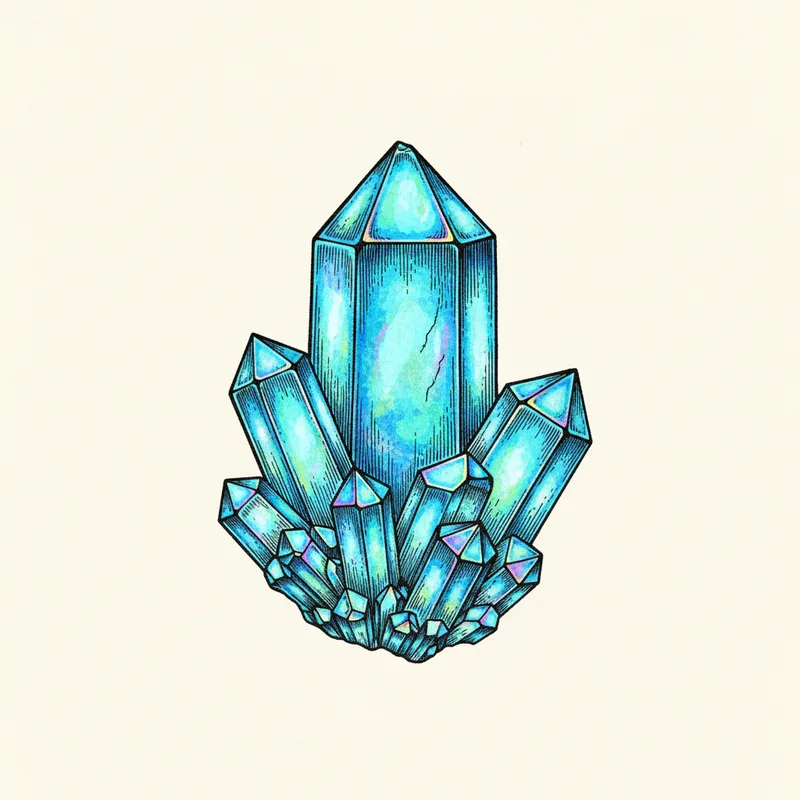
Aqua Aura Quartz
The Gold-Bonded Crystal
Affiliate links. We may earn a commission, at no cost to you.
Quick Facts
Formation & Origin
Aqua aura quartz is not a natural mineral. It is created through a process called chemical vapor deposition (CVD). Clear quartz crystals are placed in a vacuum chamber and heated to approximately 871°C (1600°F). Vaporized gold is then introduced into the chamber, where the gold atoms bond permanently to the surface of the quartz crystal at a molecular level.
The result is an extremely thin but permanent coating of gold (only a few atoms thick) that produces an intense electric blue color through thin-film interference. The gold doesn't just sit on the surface like paint, but forms a permanent molecular bond with the silicon dioxide of the quartz, making the color extremely durable.
While entirely man-made in terms of the treatment, both components (natural quartz and pure gold) are genuine. The process was developed in the 1980s and has since spawned many variations using different metals: titanium (rainbow aura), platinum (angel aura), copper and titanium (flame aura), among others.
Identification Guide
Aqua aura quartz is identified by its vivid electric blue color with iridescent metallic sheen on a clearly crystalline quartz base. The blue color is too intense and metallic to be any natural blue mineral. The underlying quartz crystal morphology (hexagonal prisms, points) is clearly visible.
Distinguish from natural blue quartz (much paler, no metallic sheen), coated glass (quartz shows natural crystal faces, not molded shapes), and dyed quartz (dye concentrates in fractures, while aura coating is uniform on surfaces). The permanent, even coating that follows crystal faces is characteristic of genuine CVD treatment.
Spotting Fakes
The 'fake' issue with aqua aura quartz is inverted: it's already a treated stone, so the concern is whether the treatment is real CVD gold bonding or simply painted or dyed. Genuine aqua aura has a permanent coating that won't scratch off with a fingernail or dissolve in acetone. The color should be even across surfaces but may be slightly thicker in crevices. Cheap imitations use spray paint or metallic coatings that rub off. The base crystal should be genuine quartz.
Some links in this post go to Amazon and Etsy. Crystal Almanac earns a commission from qualifying purchases at no extra cost to you. Tools recommended here are ones we would use ourselves to run the tests described - the recommendation comes first, the link is downstream of it.
Cultural & Metaphysical Traditions
Presented as cultural traditions, not scientific evidence
Despite being a treated stone, aqua aura quartz has developed a significant following in crystal healing since the 1980s. Practitioners associate the gold-quartz combination with communication, psychic enhancement, and aura cleansing. The gold bonding is seen as permanently altering the crystal's energy signature. Some purists prefer natural minerals, but aqua aura has earned its own distinct tradition.
Metaphysical and “healing” associations are cultural traditions, not medical advice or scientific fact. Crystals are not a substitute for professional medical care.
Where It's Found
Treatment process, not a natural mineral
Common source of base quartz crystals
Another source for high-quality base quartz
Price Guide
Good to Know
Scratch test: At hardness 7, Aqua Aura Quartz can scratch glass and steel. It's durable enough for any type of jewelry.
Global supply: Found in 3 notable locations worldwide, from Manufactured to Arkansas.
Heft test: Aqua Aura Quartz has average mineral density (2.65). It feels about as heavy as you'd expect from a stone its size.
Common Questions
What is the chemical formula of Aqua Aura Quartz?
The chemical formula of Aqua Aura Quartz is SiO₂ + Au (vapor-deposited gold film).
What is Aqua Aura Quartz's Mohs hardness?
Aqua Aura Quartz has a Mohs hardness of 7 on the 1 to 10 Mohs scale, hard enough to scratch glass and stand up to daily wear.
Is Aqua Aura Quartz a mineral?
Yes. Aqua Aura Quartz is a naturally occurring mineral (Treated Quartz) with a definite chemical composition and an ordered crystal structure.
Care & Safety
The water, salt, and sunlight questions people actually ask before cleansing or displaying aqua aura quartz, answered from its hardness (Mohs 7) and chemistry (SiO₂ + Au (vapor-deposited gold film)).
Can Aqua Aura Quartz go in water?
Yes. Aqua Aura Quartz is hard (Mohs 7) and chemically stable, so a rinse or a quick wash with mild soap is no problem, cleanse it in water freely if that is your practice. A long soak does nothing for it either way, so skip that, and dry the stone afterward.
Can Aqua Aura Quartz go in salt water?
Not recommended, even though aqua aura quartz itself is hard and not water-soluble. Salt is both corrosive and mildly abrasive: it can dull a polished surface, attack metal settings, and crystallize inside small fractures as the stone dries. A quick dip will not destroy aqua aura quartz, but rinse it with fresh water afterward and dry it. For routine cleaning, plain water is the kinder choice.
Sources & References
The mineralogical and gemological data on this page is drawn from and can be cross-checked against these external references.
- WikipediaQuartz on Wikipedia
- WebmineralQuartz mineral data (Webmineral)
- Handbook of MineralogyQuartz (Handbook of Mineralogy, PDF)
Related Minerals
The base mineral before treatment
Platinum/silver vapor-deposited variety
Titanium/niobium-treated variety
Explore More
Save This Stone

Keep this aqua aura quartz reference handy. Save the card to a Pinterest board and the profile is one tap away.
Save to PinterestNewsletter
Something shiny, now and then
A stone worth knowing, or a fake worth spotting, every so often. No spam.