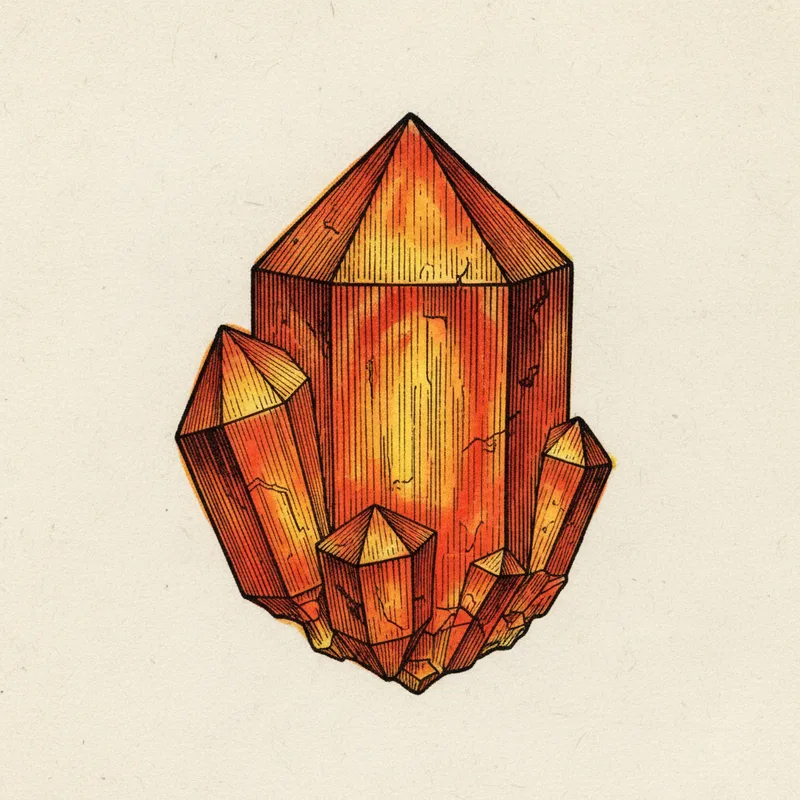
Zincite
The Neon Zinc Crystal
Affiliate links. We may earn a commission, at no cost to you.
Quick Facts
Formation & Origin
Zincite is a zinc oxide mineral (ZnO), rare in nature and best known from the Franklin and Sterling Hill deposits in New Jersey. Natural zincite is one of the rarest minerals on Earth, found in significant quantities at only one location: the Franklin and Sterling Hill zinc mines in New Jersey. There, it formed through high-temperature metamorphism of zinc-rich limestone, creating massive deposits alongside franklinite and willemite.
The Franklin deposit is unique in geology: a Precambrian zinc-manganese ore body metamorphosed to create an extraordinary assemblage of over 350 mineral species, including dozens found nowhere else on Earth. Zincite's vivid red-orange color comes from manganese substituting for zinc in the crystal structure.
Most 'zincite crystals' on the market are actually synthetic, produced accidentally in the chimneys of zinc smelters in Poland. When zinc oxide vapors condense in smelter flues, they form vivid, well-crystallized specimens. These are genuine zinc oxide with the same chemistry and structure as natural zincite, but their origin is industrial rather than geological.
Identification Guide
Natural zincite from Franklin is identified by its deep red-orange color, high specific gravity (5.66, noticeably heavy), and association with franklinite (black) and willemite (green-fluorescing). It's typically massive rather than crystalline at Franklin.
Distinguish from crocoite (lead chromate, different streak), cinnabar (mercury sulfide, different streak), and wulfenite (lead molybdate, tabular crystals). The Polish synthetic crystals are well-formed hexagonal prisms with vivid colors, and their origin should be disclosed by sellers.
Spotting Fakes
The main issue is synthetic vs. natural confusion. Well-crystallized, vivid orange or green zincite specimens are almost certainly from Polish smelters, not natural. Natural zincite from Franklin is massive (not crystallized), deep red, and comes in association with franklinite and willemite. Both natural and synthetic are genuinely ZnO, but they command very different prices. Natural Franklin zincite specimens are rare and valuable, while Polish synthetic crystals are affordable.
Some links in this post go to Amazon and Etsy. Crystal Almanac earns a commission from qualifying purchases at no extra cost to you. Tools recommended here are ones we would use ourselves to run the tests described - the recommendation comes first, the link is downstream of it.
Cultural & Metaphysical Traditions
Presented as cultural traditions, not scientific evidence
Zincite is associated with creativity, personal power, and life force energy in crystal healing. Practitioners connect its vivid color to the sacral and solar plexus chakras. The distinction between natural and synthetic is debated in metaphysical circles, with some practitioners asserting that smelter-produced specimens carry different energy than natural ones.
Metaphysical and “healing” associations are cultural traditions, not medical advice or scientific fact. Crystals are not a substitute for professional medical care.
Where It's Found
World's only significant natural source, legendary fluorescent locality
Synthetic zincite crystals from smelter operations
Minor earthy occurrences
Price Guide
Good to Know
Scratch test: At hardness 4, Zincite can be scratched with a copper coin. Handle gently and keep away from harder stones in your collection.
Global supply: Found in 3 notable locations worldwide, from United States to Spain.
Heft test: With a specific gravity of 5.66, Zincite feels surprisingly heavy for its size. This weight is actually a useful identification tool.
Common Questions
What is the chemical formula of Zincite?
The chemical formula of Zincite is ZnO.
What is Zincite's Mohs hardness?
Zincite has a Mohs hardness of 4 on the 1 to 10 Mohs scale, which a steel knife will scratch.
Is Zincite a mineral?
Yes. Zincite is a naturally occurring mineral (Oxide Mineral) with a definite chemical composition and an ordered crystal structure.
Care & Safety
The water, salt, and sunlight questions people actually ask before cleansing or displaying zincite, answered from its hardness (Mohs 4) and chemistry (ZnO).
Can Zincite go in water?
Only briefly. A quick rinse under running water is fine for zincite, but do not let it soak or sit submerged. At Mohs 4 it is tough enough for a rinse but not for a long soak. Dry it thoroughly afterward.
Can Zincite go in salt water?
No. Zincite can take a brief fresh-water rinse and nothing more, and salt water is harder on it both ways: corrosive while wet, then abrasive as the salt dries into crystals. If it does meet salt water, rinse it with fresh water and dry it promptly.
Sources & References
The mineralogical and gemological data on this page is drawn from and can be cross-checked against these external references.
- WikipediaZincite on Wikipedia
- WebmineralZincite mineral data (Webmineral)
- Handbook of MineralogyZincite (Handbook of Mineralogy, PDF)
Related Minerals
Fellow Franklin mineral, famous for green fluorescence
Another Franklin mineral, zinc-iron-manganese oxide
Similar red oxide mineral (copper instead of zinc)
Explore More
Save This Stone

Keep this zincite reference handy. Save the card to a Pinterest board and the profile is one tap away.
Save to PinterestNewsletter
Something shiny, now and then
A stone worth knowing, or a fake worth spotting, every so often. No spam.