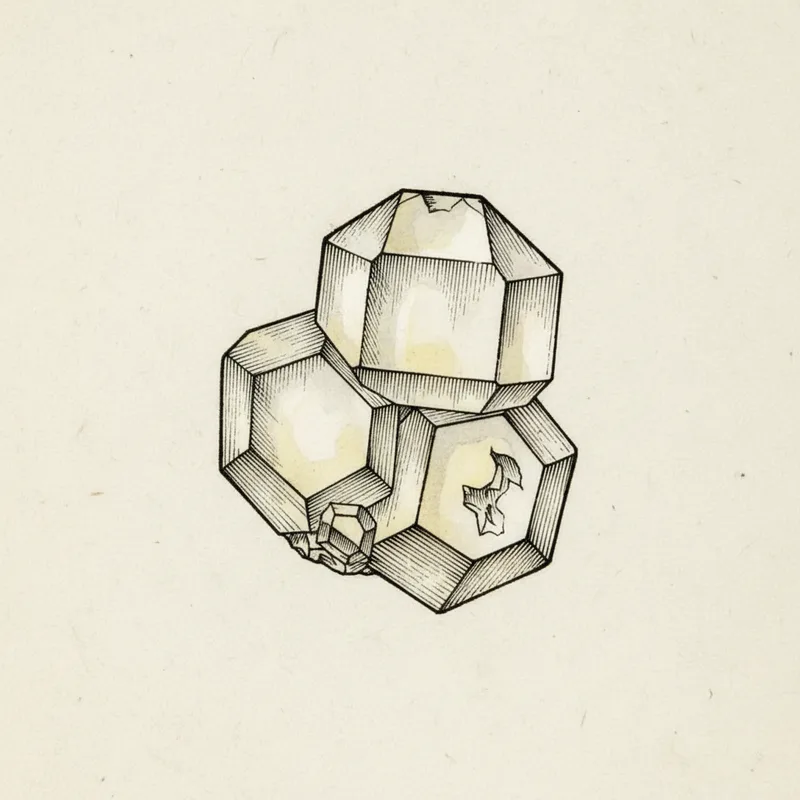
Phenakite
The Deceiver's Crystal
Affiliate links. We may earn a commission, at no cost to you.
Quick Facts
Formation & Origin
Phenakite (also spelled phenacite) is a beryllium silicate named from the Greek 'phenax' meaning 'deceiver,' because it was frequently mistaken for quartz. The two minerals share similar appearance, transparency, and hardness, but phenakite has different crystal symmetry and optical properties.
It forms in granitic pegmatites and hydrothermal veins alongside other beryllium minerals like emerald, chrysoberyl, and bertrandite. The beryllium-rich environments that produce emerald occasionally also produce phenakite, making them geological companions.
Phenakite's significance lies partly in its beryllium content: it's one of the few beryllium minerals transparent and hard enough for gemstone use. Faceted phenakite can be strikingly brilliant, with a vitreous luster and good dispersion. However, its relative obscurity keeps it a collector's gem rather than a mainstream jeweler's stone.
Identification Guide
Phenakite is identified by its colorless to pale transparency, trigonal crystal system, hardness 7.5 (slightly harder than quartz), and RI of 1.654-1.670 (higher than quartz's 1.544-1.553). Crystals are often rhombohedral or prismatic.
Distinguish from quartz (lower RI, different crystal habit), topaz (orthorhombic, perfect cleavage), and white sapphire (higher RI and SG). The RI reading is the most practical way to separate phenakite from quartz.
Spotting Fakes
Phenakite is most often confused with quartz rather than deliberately faked. The key test is refractive index: phenakite at 1.654-1.670 is significantly higher than quartz at 1.544-1.553. If you have a colorless crystal from a pegmatite that looks like quartz but gives a higher RI reading, it may be phenakite. Lab testing is recommended for valuable specimens.
Some links in this post go to Amazon and Etsy. Crystal Almanac earns a commission from qualifying purchases at no extra cost to you. Tools recommended here are ones we would use ourselves to run the tests described - the recommendation comes first, the link is downstream of it.
Cultural & Metaphysical Traditions
Presented as cultural traditions, not scientific evidence
Phenakite is considered one of the highest-vibration crystals in healing traditions, associated with spiritual awakening, interdimensional awareness, and accelerated personal evolution. Its 'deceiver' name is reinterpreted as the ability to see through illusion to deeper truth. Its rarity and association with emerald deposits add to its metaphysical reputation.
Metaphysical and “healing” associations are cultural traditions, not medical advice or scientific fact. Crystals are not a substitute for professional medical care.
Where It's Found
Fine transparent crystals
Classic specimens alongside emerald
Gem-quality crystals
Large transparent crystals
Price Guide
Good to Know
Scratch test: At hardness 7.5, Phenakite can scratch glass and steel. It's durable enough for any type of jewelry.
Global supply: Found in 4 notable locations worldwide, from Brazil to Nigeria.
Heft test: Phenakite has average mineral density (2.93-2.97). It feels about as heavy as you'd expect from a stone its size.
Common Questions
What is the chemical formula of Phenakite?
The chemical formula of Phenakite is Be₂SiO₄.
What is Phenakite's Mohs hardness?
Phenakite has a Mohs hardness of 7.5 on the 1 to 10 Mohs scale, hard enough to scratch glass and stand up to daily wear.
Is Phenakite a mineral?
Yes. Phenakite is a naturally occurring mineral (Silicate Mineral (Nesosilicate)) with a definite chemical composition and an ordered crystal structure.
Care & Safety
The water, salt, and sunlight questions people actually ask before cleansing or displaying phenakite, answered from its hardness (Mohs 7.5) and chemistry (Be₂SiO₄).
Can Phenakite go in water?
Yes. Phenakite is hard (Mohs 7.5) and chemically stable, so a rinse or a quick wash with mild soap is no problem, cleanse it in water freely if that is your practice. A long soak does nothing for it either way, so skip that, and dry the stone afterward.
Can Phenakite go in salt water?
Not recommended, even though phenakite itself is hard and not water-soluble. Salt is both corrosive and mildly abrasive: it can dull a polished surface, attack metal settings, and crystallize inside small fractures as the stone dries. A quick dip will not destroy phenakite, but rinse it with fresh water afterward and dry it. For routine cleaning, plain water is the kinder choice.
Sources & References
The mineralogical and gemological data on this page is drawn from and can be cross-checked against these external references.
- WikipediaPhenakite on Wikipedia
- WebmineralPhenakite mineral data (Webmineral)
- Handbook of MineralogyPhenakite (Handbook of Mineralogy, PDF)
Explore More
Save This Stone

Keep this phenakite reference handy. Save the card to a Pinterest board and the profile is one tap away.
Save to PinterestNewsletter
Something shiny, now and then
A stone worth knowing, or a fake worth spotting, every so often. No spam.