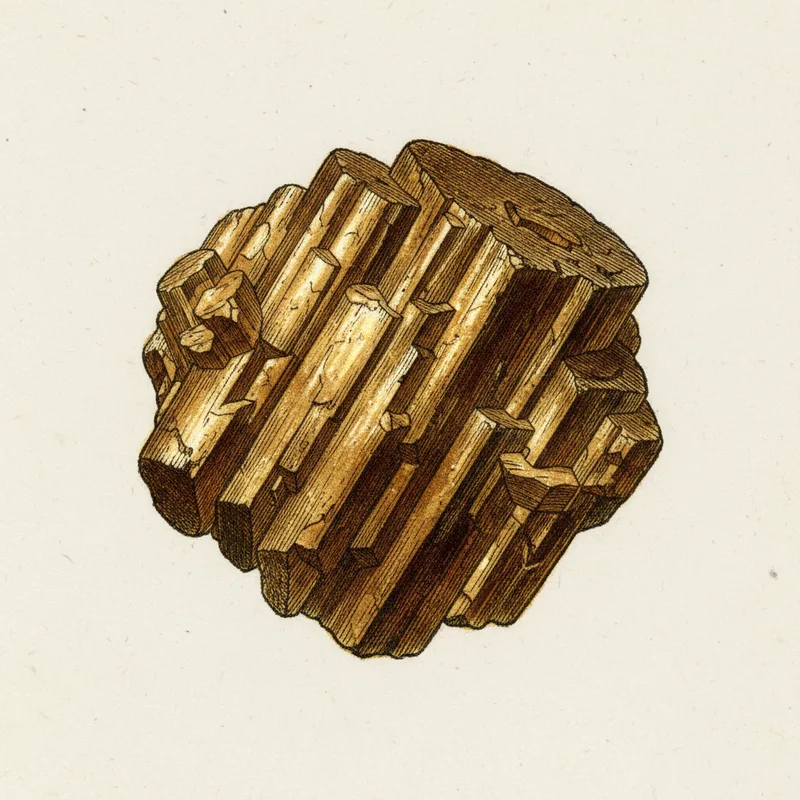
Bronzite
The Bronze Shield
Affiliate links. We may earn a commission, at no cost to you.
Quick Facts
Formation & Origin
Bronzite is an iron-bearing variety of enstatite, a pyroxene mineral. It forms in mafic and ultramafic igneous rocks, particularly in gabbros, norites, and peridotites. The bronze-like metallic shimmer (schiller) that gives it its name comes from microscopic platy inclusions of iron oxide arranged along cleavage planes.
When light enters the mineral and reflects off these internal inclusions, it creates a warm bronze to golden-brown chatoyant effect. This submetallic luster distinguishes bronzite from other brown minerals and gives polished specimens a distinctive warm glow.
Bronzite is an intermediate member of the enstatite-ferrosilite solid solution series. Specimens with less than about 12% iron component are classified as enstatite, while those with more iron shift toward hypersthene. Bronzite falls in the middle range.
Identification Guide
Bronzite is identified by its warm brown color with distinctive bronze metallic shimmer (schiller). This chatoyant effect is visible in polished specimens when tilted in light. Hardness of 5.5, two cleavage directions at nearly 90 degrees (characteristic of pyroxenes), and association with mafic rocks are additional identifiers.
Distinguish from tiger eye (fibrous, quartz-based chatoyancy), bronzy biotite (softer, micaceous), and hypersthene (more iron-rich, darker). The warm bronze shimmer on a dark brown base is bronzite's signature look.
Spotting Fakes
Bronzite is inexpensive and not commonly faked. Some 'bronzite' on the market may actually be hypersthene or other dark pyroxene minerals, but the distinction is mainly academic for non-gem material. The schiller effect should be natural and visible from multiple angles. Painted or coated stones will lack the depth of natural schiller.
Some links in this post go to Amazon and Etsy. Crystal Almanac earns a commission from qualifying purchases at no extra cost to you. Tools recommended here are ones we would use ourselves to run the tests described - the recommendation comes first, the link is downstream of it.
Cultural & Metaphysical Traditions
Presented as cultural traditions, not scientific evidence
Bronzite is considered a protective stone that deflects negative energy back to its source, functioning like a metaphysical mirror. The bronze shield analogy connects it to courage, self-assurance, and standing firm under pressure. Practitioners use it for building confidence in difficult social situations and establishing healthy boundaries.
Metaphysical and “healing” associations are cultural traditions, not medical advice or scientific fact. Crystals are not a substitute for professional medical care.
Where It's Found
Classic European specimens
Major commercial source for polished material
Associated with platinum deposits
Tumbled stone market supply
Price Guide
Good to Know
Scratch test: At hardness 5.5, Bronzite resists scratching from a knife but can be scratched by quartz. Best for pendants and earrings rather than rings.
Global supply: Found in 4 notable locations worldwide, from Austria to Brazil.
Heft test: Bronzite has average mineral density (3.2-3.5). It feels about as heavy as you'd expect from a stone its size.
Common Questions
What is the chemical formula of Bronzite?
The chemical formula of Bronzite is (Mg,Fe)₂Si₂O₆.
What is Bronzite's Mohs hardness?
Bronzite has a Mohs hardness of 5.5 on the 1 to 10 Mohs scale, hard enough to scratch glass but softer than quartz.
Is Bronzite a mineral?
Yes. Bronzite is a naturally occurring mineral (Pyroxene Group (Silicate)) with a definite chemical composition and an ordered crystal structure.
Care & Safety
The water, salt, and sunlight questions people actually ask before cleansing or displaying bronzite, answered from its hardness (Mohs 5.5) and chemistry ((Mg,Fe)₂Si₂O₆).
Can Bronzite go in water?
Yes. Bronzite is not water-soluble and durable enough (Mohs 5.5), so a rinse or a quick wash with mild soap is no problem, cleanse it in water freely if that is your practice. A long soak does nothing for it either way, so skip that, and dry the stone afterward.
Can Bronzite go in salt water?
Not recommended, even though bronzite itself is hard and not water-soluble. Salt is both corrosive and mildly abrasive: it can dull a polished surface, attack metal settings, and crystallize inside small fractures as the stone dries. Bronzite's iron content also makes rust staining likely if salt residue sits on the surface. A quick dip will not destroy bronzite, but rinse it with fresh water afterward and dry it. For routine cleaning, plain water is the kinder choice.
Sources & References
The mineralogical and gemological data on this page is drawn from and can be cross-checked against these external references.
- WikipediaBronzite on Wikipedia
- WebmineralEnstatite mineral data (Webmineral)
- Handbook of MineralogyEnstatite (Handbook of Mineralogy, PDF)
Explore More
Pyroxene & Amphibole
The Protection Collection
Called the 'bronze shield' for its metallic shimmer and reputation for deflecting negative energy back to its source. The warm, grounded energy builds self-assurance under pressure.
Mohs Hardness Scale
See where Bronzite sits on the scale
Crystal Care Guide
Water safety, sunlight, and handling tips
Save This Stone

Keep this bronzite reference handy. Save the card to a Pinterest board and the profile is one tap away.
Save to PinterestNewsletter
Something shiny, now and then
A stone worth knowing, or a fake worth spotting, every so often. No spam.